
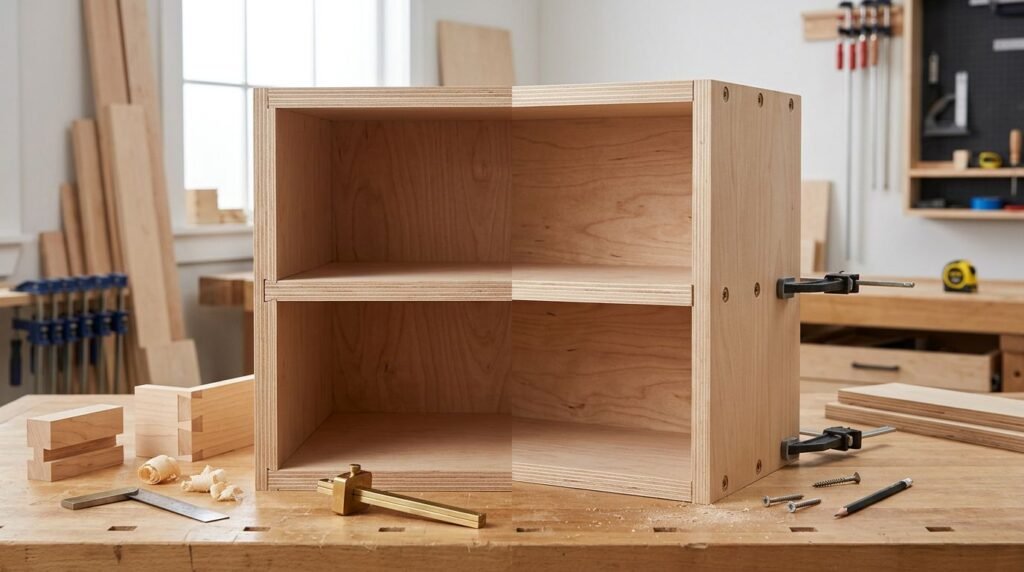
A beautiful cabinet door can hide a weak box. Since the box carries the shelves, drawers, countertop weight, and daily use, its corner connections deserve as much attention as the finish.
Cabinet box joinery describes how the cabinet’s sides, bottom, top, and back connect. You don’t need to become a woodworker before buying, but knowing a few terms helps you compare quotes and showroom samples with confidence.
Cabinet Box Joinery: What It Tells You
Joinery is the method that holds cabinet panels together. Some methods rely mainly on screws or staples. Others lock panels into grooves, recesses, or drilled holes before glue and fasteners secure the assembly.
The strongest choice depends on the cabinet material, panel thickness, hardware, and intended use. A sink base faces different stresses than a small upper cabinet. For a fuller view of what to inspect beyond the door style, review these quality cabinet construction checks.
| Joinery type | How it connects panels | What homeowners should inspect |
|---|---|---|
| Butt joint | Two square-cut edges meet | Fasteners, glue, and panel thickness |
| Dado or rabbet | One panel fits into a groove or recessed edge | Tight fit and clean assembly |
| Dowel joint | Wood dowels align drilled holes | Accurate alignment and firm corners |
| Cam-lock fitting | Hardware pulls pre-drilled panels together | Hardware quality and intended use |
A cabinet box should feel square and rigid when you press on its sides or gently pull at the front corner. Movement, gaps, or a thin back panel can matter more than an impressive-sounding joinery label.
The joint is only one part of the build
A strong corner joint cannot fully compensate for weak box material. Plywood, furniture-grade particleboard, and MDF all perform differently when exposed to weight, humidity, or a plumbing leak.
Likewise, a substantial back panel adds stiffness, and this guide to cabinet back panel construction explains what to compare before you order. A cabinet with solid corner connections but a thin back simply stapled to the edges may still flex during installation or over years of use.
Butt Joints: Simple Construction With Wide Variation
A butt joint is the most basic cabinet connection. One panel meets another at a square edge, such as a cabinet side meeting the bottom panel. Manufacturers then secure it with glue, screws, staples, nails, or a combination of these.
This construction isn’t automatically poor quality. A well-made butt joint with adequate material, glue, and properly placed screws can work well in many framed and frameless cabinets. However, the details make a major difference.
Screws offer more confidence than staples alone
Staples help hold parts while glue cures, and they are common in efficient factory production. Yet a corner held mostly by staples offers less mechanical strength than one reinforced with screws, dowels, or interlocking cuts.
Ask to see the interior or underside of a sample. Look for screws placed at the cabinet’s load-bearing corners, rather than only a row of staples along an edge. In particleboard boxes, confirmat screws are often used because their deep threads grip engineered wood better than ordinary wood screws.
Where butt joints make practical sense
Butt-joint construction can suit wall cabinets, utility cabinets, and budget-conscious projects when the box remains stiff and the manufacturer uses dependable materials. It may also make repairs more straightforward.
Still, wide drawer bases, tall pantry cabinets, and sink cabinets face greater stress. In those locations, ask whether the manufacturer adds dowels, reinforcing blocks, thicker material, or a captured back panel.
A cabinet joint should match the load it carries. The same construction that works in a small upper cabinet may be less convincing under a heavy countertop and a full bank of drawers.
Dado and Rabbet Joints Add Mechanical Support
Dado and rabbet joints use shaped cuts to give one panel a physical seat inside another. They create more glue surface than a simple edge-to-edge connection and help keep cabinet parts aligned during assembly.
A dado is a groove cut into a panel. A rabbet is a recess cut along a panel’s edge. Cabinet makers may use these cuts for bottoms, backs, tops, or shelf supports.
Grooves help panels resist shifting
When a cabinet bottom sits in a dado in each side panel, the groove helps carry the load. Glue and fasteners then hold the cabinet together, while the shaped connection helps prevent the bottom from sliding out of position.
Similarly, a back set into rabbets around the cabinet perimeter can stiffen the entire box. This matters for wall cabinets, because the back often works with the hanging rail or mounting system to support the cabinet safely.
Inspect fit, not only terminology
A dado or rabbet should fit tightly, with clean edges and no visible gaps. Sloppy machining can reduce the advantage of the joint, even when the product description uses strong construction language.
Also ask whether the back panel sits in a recessed channel or attaches flat against the rear edges. A captured back usually creates a more rigid cabinet than a thin panel fastened only at the perimeter.
Dowel Joinery Keeps Factory-Made Boxes Aligned
Dowel joinery uses short wooden pins inserted into matching holes in adjoining panels. Glue bonds the dowels and panel faces together. Because dowels locate each part precisely, they can produce clean, square cabinet boxes without visible screws.
Manufacturers often use automated drilling equipment for doweled construction. When the holes align accurately, the result can be a neat, strong connection with little room for a box to rack out of square.
Dowel joints work best with accurate machining
Dowels need precise hole placement. If a manufacturer drills poorly or uses too little adhesive, the joint loses much of its value. Fortunately, a finished sample offers useful clues.
Check whether the box corners sit flush. Open and close drawers, then look at the reveals around doors. Although door adjustment can correct minor issues, a cabinet that starts square is easier to install and keep aligned, especially once you know how to join cabinet boxes into one straight run.
Ask how the joint handles real use
Doweled boxes can be an excellent choice for kitchens and bathrooms, especially when paired with solid panel materials and a properly fitted back. However, dowels aren’t a reason to overlook other details.
Ask about shelf thickness, drawer-slide mounting, back construction, and the warranty. A polished cabinet design includes dependable interior construction, not only a coordinated door style and hardware finish.
Cam-Lock Joinery Is Common in Ready-to-Assemble Cabinets
Cam-lock joinery uses metal cams and connector bolts. Turning the cam pulls two pre-drilled panels together. This system is common in ready-to-assemble cabinetry because it ships flat and assembles without extensive shop equipment.
For a light-duty closet organizer or temporary storage piece, cam-lock fittings can be a sensible option. In a permanent kitchen or bathroom, assess the product more carefully.
Hardware quality and assembly affect performance
A cam connection depends on precise holes, sturdy hardware, and correct assembly. Over-tightening can damage particleboard around the fitting. Repeated disassembly can also weaken the holes and reduce holding power.
Look for thick panels, clear assembly instructions, and a cabinet that uses wall fasteners or rails suited to its installation method. Cabinets that will carry stone countertops, heavy drawers, or large appliances need construction that supports those loads.
Flat-pack does not always mean flimsy
Some ready-to-assemble systems are thoughtfully engineered. Others prioritize a low initial price over long-term repairability. Treat the joint type as a starting point, then compare the entire construction package.
A sturdy cam-lock box with moisture-resistant material and a substantial back may suit a secondary room. Yet a cabinet with cheap hardware, exposed raw edges, and thin panels remains a risk regardless of how neatly it assembles.
Compare the Box Material and Back Panel Too
Cabinet box joinery works with the materials around it. Plywood generally holds screws well and tends to tolerate brief moisture exposure better than standard particleboard. MDF has a smooth, consistent surface but can swell badly when water reaches unprotected edges.
Material names alone don’t settle the question. Thickness, finish coverage, edge treatment, and location all matter. For instance, a well-sealed engineered-wood upper cabinet may perform well, while a sink base needs added attention around plumbing and possible leaks.
Look closely at wet and high-stress areas
Open the sink cabinet sample. Check whether exposed edges have a finished surface, edge banding, or another seal. Ask how the manufacturer treats the bottom panel and toe-kick area.
In Southwest Florida, humidity and air-conditioning cycles make material stability a practical concern. This comparison of plywood versus MDF cabinet boxes can help you weigh those materials for local conditions.
Use a sample cabinet as your buying checklist
Before accepting broad claims such as “premium construction” or “all-wood cabinets,” inspect a full cabinet box and ask direct questions:
- Press the side, top, and back panels to check for flex.
- Look inside corners for screws, dowels, grooves, or reinforcement blocks.
- Confirm the material and thickness of the sides, shelves, and back.
- Ask how the cabinet back attaches and how installers fasten wall cabinets.
- Examine exposed edges near sink bases, dishwashers, and bathroom vanities.
- Request construction details in writing when comparing estimates.
A clear quote should identify box material, construction method, drawer construction, hardware, and warranty terms. If those details are absent, comparison becomes guesswork.
Match the Joinery to Your Room and Budget
There is no single cabinet joint that fits every home and every budget. A compact guest bathroom may not need the same construction level as a busy kitchen with wide drawers, a heavy countertop, and daily family traffic.
Prioritize robust connections for sink bases, drawer banks, tall pantry cabinets, and wall cabinets that will hold dishes. Meanwhile, decorative upper cabinets or low-use storage may allow more flexibility if the overall build remains solid.
Choose details that support your daily routine
Construction should support how you live. If you store cast-iron cookware, use pull-out shelves, or want deep drawers for dishes, ask about the box and slide system that will carry that weight.
Your layout also affects the right specification. A large island, uneven walls, tall ceilings, or a tight appliance wall may call for different box sizes and reinforcement. A cabinet design consultation can connect these construction choices with accurate measurements, storage needs, and finish selections before you commit.
Read marketing terms with a practical eye
“Furniture-grade,” “solid wood,” and “premium” can describe different features from one brand to another. Solid wood often refers to doors or face frames, not necessarily the cabinet box. Similarly, a dovetailed drawer is a positive detail, but it doesn’t prove that the cabinet box uses equally strong joinery.
Request a sample, a specification sheet, and a written explanation of any construction claim that affects price. You are buying a complete cabinet system, not a single feature.
Choose Construction You Can Verify
The best cabinet purchase begins behind the doors. Look for rigid boxes, appropriate materials, well-fitted panels, and joinery that suits the cabinet’s location and workload.
A simple joint assembled with care can outperform a fancier joint paired with thin panels or poor moisture protection. Cabinet box joinery matters most when it works with sound materials, a solid back, and a design that fits your home.