
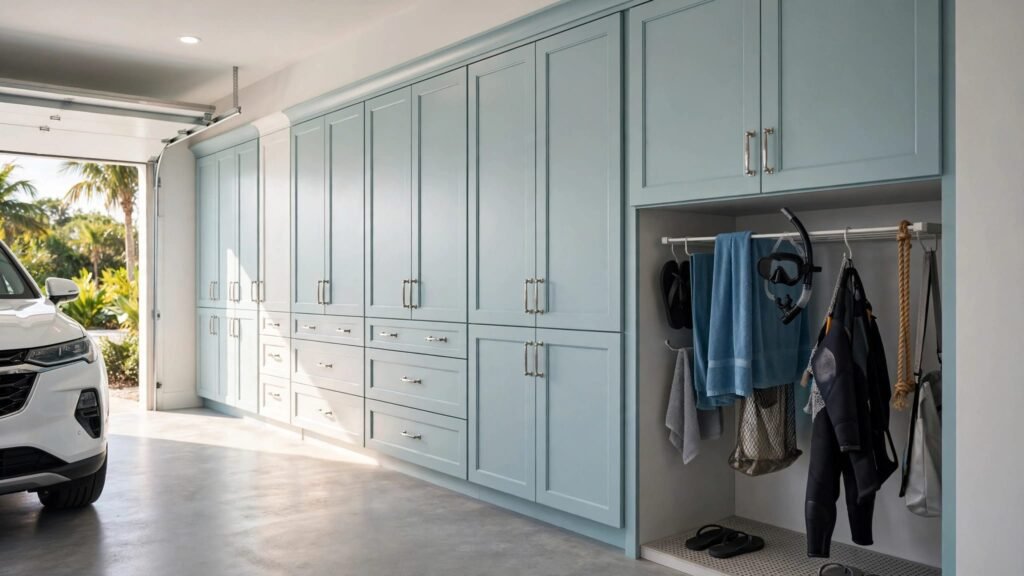
Your garage cabinets face a tougher environment than the cabinets inside your kitchen. In Southwest Florida, heat, humid air, damp beach gear, and coastal exposure can affect cabinet boxes and hardware.
Choosing garage cabinets for Southwest Florida homes starts with exposure conditions, then a layout that leaves room for vehicles and daily use. You can carry your home’s style into the garage, but the construction needs its own specifications.
Start by assessing the space before choosing doors, finishes, or storage accessories.
Key Takeaways
- Match cabinet materials to the garage’s actual heat, moisture, and salt exposure.
- Look beyond door finishes to sealed edges, cabinet interiors, hinges, and drawer slides.
- Give wet gear a drying area before moving it into enclosed storage.
- Measure with vehicles parked and the garage door fully open.
- Compare complete installed proposals, including mounting, hardware, and any utility changes.
Assess Your Garage’s Heat and Moisture Exposure
Separate humidity from direct water exposure
A closed, air-conditioned garage presents different conditions than an unconditioned garage opened throughout the day. Rainwater carried in by tires, wet equipment, and occasional leaks add another level of exposure.
Before ordering, check for damp walls, staining, musty odors, and water near the garage door. Resolve leaks and drainage problems first. New cabinetry won’t correct a moisture problem behind it.
The construction principles behind humidity-resistant cabinets in Fort Myers also matter here: stable boxes, protected edges, and durable finishes. However, indoor kitchen guidance doesn’t establish that a product suits an unconditioned garage.
Account for coastal conditions
Homes near saltwater may need more corrosion-resistant hardware than properties farther inland. Because exposure varies, ask about the actual metal and protective finish rather than accepting a general “rust-resistant” description.
Also consider sunlight through windows and heat near the garage door. Confirm the manufacturer’s intended environment, temperature limitations, and warranty exclusions.
Even attractive kitchen cabinetry needs this review before it becomes garage storage.
Compare Practical Garage Cabinet Materials
Each material handles moisture differently, and construction quality changes the result.
| Material | Practical advantage | Main concern |
|---|---|---|
| Cabinet-grade plywood | Strong boxes with good structural stability | Exposed edges and prolonged wetting |
| MDF or particleboard | Smooth surfaces and economical options | Swelling after moisture reaches the core |
| Powder-coated steel | Durable storage for tools and equipment | Rust at scratches, seams, or damaged coatings |
| Aluminum | Lightweight and corrosion-resistant | Finish quality, joints, and hardware |
| Stainless steel | Durable, washable surfaces | Grade, cost, and coastal maintenance |
| HDPE polymer | Water-resistant cabinet panels | Stiffness, load capacity, and product construction |
The complete assembly matters as much as the panel material. A metal cabinet with vulnerable hinges still has a corrosion problem.
Quality plywood can suit protected conditions when its edges and surfaces are properly sealed. However, it remains a wood product and can suffer damage from standing water.
The distinction between plywood and MDF cabinet boxes is useful when comparing proposals. Moisture-resistant MDF may suit dry, protected areas, but that designation doesn’t make it waterproof. Standard particleboard deserves caution where wetting is likely.
For greater moisture exposure, consider products built with aluminum, stainless steel, or marine-grade polymers. Type 316 stainless steel offers greater resistance to chloride corrosion than Type 304, although neither eliminates maintenance.
HDPE, or high-density polyethylene, doesn’t swell like wood-based panels. Still, verify shelf support and rated loads. If sunlight reaches the cabinets, ask whether the polymer includes UV protection.
Specify Finishes and Hardware Together
Protect edges, interiors, and joints
A smooth laminate face doesn’t protect an unfinished edge or an unsealed fastener hole. Ask how the manufacturer finishes cut edges, cabinet backs, shelf holes, and joints.
Likewise, “laminate cabinetry” describes a surface, not necessarily the material underneath. Confirm whether the core is plywood, MDF, or particleboard.
Painted and stained wood need a suitable protective coating. Thermofoil products also require review of their heat limitations because excessive heat can affect the film or adhesive.
Simple slab doors are easy to wipe down and have fewer dust-catching details than elaborate profiles.
Choose hardware for the expected use
Hinges, slides, pulls, and mounting hardware should match the garage’s exposure conditions. Ask for corrosion-resistance information and replacement availability.
Soft-close operation adds comfort, but load ratings matter more when drawers hold tools. Confirm whether the rating applies to the complete drawer assembly.
Choose pulls you can grip comfortably, including when your hands are damp or you’re wearing work gloves.
Plan Ventilation Without Trapping Moisture
Give damp equipment somewhere to dry
Beach chairs, pool accessories, and gardening equipment shouldn’t move directly into tightly enclosed cabinets while wet. Instead, create an open drying area with hooks or washable shelving.
Ventilated cabinet doors can help air circulate, but they don’t guarantee that stored items will dry. The surrounding garage air still affects drying time.
The transition-storage approach used in Fort Myers mudroom cabinet ideas also helps organize the garage entry. Keep sandy shoes and damp equipment near the arrival point, separate from dry household supplies.
Address the room’s humidity
A hygrometer helps you track conditions rather than relying on how the garage feels. If moisture stays high, investigate leaks and discuss suitable humidity control with a qualified professional.
A circulation fan moves air but doesn’t remove water vapor. Opening the garage to humid outdoor air can increase indoor moisture.
Dehumidification needs a suitable unit, drainage plan, and electrical setup. Meanwhile, keep required vents clear, and don’t cover air pathways with cabinetry.
Cabinet ventilation also doesn’t make an enclosed space suitable for charging batteries or storing heat-producing equipment.
Create Storage Zones Around Daily Routines
Keep everyday items near the house entry
Place frequently used supplies where you can reach them without walking around a parked vehicle. This may include reusable shopping bags, pet-walking supplies, or dry cleaning equipment.
Good cabinet design starts with the belongings you use, their dimensions, and how often you need them. Adjustable shelves handle changing storage needs better than a fixed arrangement designed around appearances.
Heavy items belong on accessible lower shelves. Reserve upper storage for lighter, less frequently used belongings.
If the garage also contains laundry equipment, leave its connections, controls, and service areas accessible.
Separate tools, recreation gear, and hazardous items
A tool zone benefits from drawers that keep small parts visible and organized. Meanwhile, tall storage can accommodate folded chairs and long-handled equipment.
Keep sharp tools and chemicals secured against children’s access. However, an ordinary locking cabinet isn’t automatically approved for flammable liquids.
Follow product labels and local fire-safety requirements for fuels and chemicals. Propane cylinders belong outdoors rather than inside enclosed garage storage.
Also review battery manufacturers’ charging and temperature instructions before creating a charging station.
Choose a Layout That Preserves Parking Space
Use one wall efficiently
A single-wall arrangement often keeps storage organized without narrowing both sides of the garage. Shallow cabinets can work beside vehicles, while deeper storage may fit better at the back.
Measure with your actual vehicles parked. Then test door openings, trunk access, walking routes, and cabinet-door swings.
Don’t choose cabinet depth solely by what fits against the wall. The useful dimension is what remains after the vehicle and moving doors occupy the space.
Open the garage door fully during planning. Tracks, springs, opener equipment, and emergency-release access can limit tall or overhead storage.
Combine tall, wall-mounted, and open storage
Tall cabinets use vertical space for bulky items, while wall cabinets keep smaller supplies off the floor. An open section can accommodate equipment that needs to dry.
Wall-mounted cabinets also make sweeping and floor cleaning easier. However, the wall and mounting system must support the loaded cabinets.
Freestanding units may need anchoring too. Have the installer account for slab slope, uneven walls, and the cabinet manufacturer’s requirements.
Leave access to electrical panels, water heaters, shutoffs, and other service equipment. Cabinet installation must also preserve any required fire separation between the garage and living space.
Compare Quotes Beyond the Cabinet Price
A useful proposal identifies the cabinet-box material, doors, finish, hardware, mounting method, and installation scope. It should also state dimensions and product load ratings.
Ask whether shelving, drawer inserts, handles, delivery, installation, and old-cabinet removal are included. Electrical work, wall repairs, and countertops can change the total.
Avoid comparing a basic freestanding cabinet price with a fully installed wall system. Instead, request matching scopes so the difference reflects construction and service.
If you’re renovating the kitchen or bathroom at the same time, coordinating colors can make the home feel consistent. TEC Cabinetry Plus’s indoor cabinet selections include KraftMaid, Fieldstone Cabinetry, and Ultracraft, among other brands.
That indoor selection doesn’t establish garage suitability. Review each proposed product’s intended use and warranty separately, especially for an unconditioned space.
Before approving production, confirm the layout, utility access, finish samples, and installation details. Also ask which maintenance products the manufacturer recommends.
Frequently Asked Questions
Can kitchen cabinets work in a Southwest Florida garage?
They can work in suitable protected conditions when the manufacturer permits that use. However, an unconditioned garage may exceed the exposure assumptions behind indoor cabinetry. Check construction, finish limitations, and warranty terms before purchasing.
Are metal garage cabinets always the better choice?
No material is best for every garage. Metal avoids wood-core swelling, but steel can rust and hardware can corrode. Compare the metal, coating, joints, and maintenance requirements against the room’s actual conditions.
Should garage cabinets sit above the floor?
Raised storage can improve cleaning access and reduce contact with routine floor moisture. It doesn’t make cabinets flood-resistant. Choose wall mounting or supported legs only after reviewing cabinet loads, wall conditions, and installation requirements.
Build Around the Conditions You Have
Garage cabinets for Southwest Florida homes need to fit both the climate and the way your household uses the space. Exposure, construction, and access should guide the selection before color or door style.
Measure around your parked vehicles, resolve moisture problems, and compare complete specifications. The right plan gives belongings a dependable home while leaving your garage comfortable to use.