
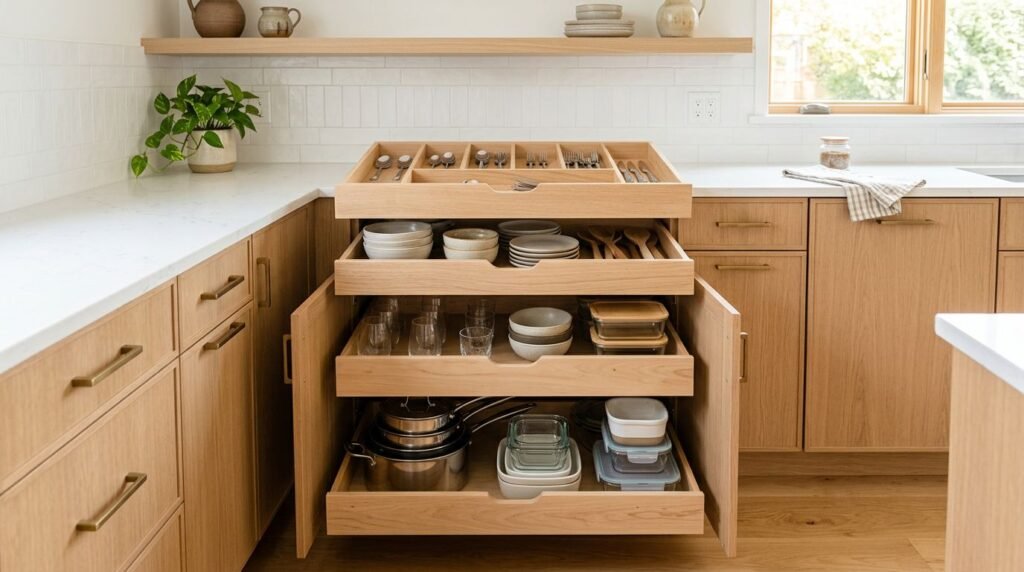
A kitchen can have beautiful cabinets and still make every meal feel like a scavenger hunt. The right cabinet drawer heights decide whether utensils, bowls, and cookware are easy to reach or buried in the wrong place.
Too-shallow drawers waste lower-cabinet space, while oversized drawers can make everyday items harder to organize. Start with what you own, then match each drawer to the job it needs to do.
Start With the Items You Use Every Day
Drawer planning works best when it begins with your actual kitchen habits. A drawer isn’t useful because it looks balanced on an elevation. It needs to hold the items you reach for, with enough room to open, close, and stay organized.
Before choosing a cabinet stack, make a quick inventory of cookware, dishes, utensils, food storage containers, and small appliances. Measure the tallest and widest items that need a home.
Map Storage Around Kitchen Tasks
Keep prep tools near the area where you chop and mix. Place plates, glasses, and flatware close to the dishwasher, so unloading takes fewer steps. Put pots, pans, and cooking utensils near the range.
This approach also prevents one oversized drawer from becoming a catchall. When every drawer has a clear role, cleanup feels easier and the countertop stays clearer.
Measure Bulky Items Before Selecting Drawers
A Dutch oven, stand mixer, blender, or stack of dinner plates needs more vertical clearance than a set of measuring spoons. Measure items with lids, handles, and bases included. Then add a little breathing room so they don’t scrape the drawer above.
Lids often create the most trouble. Storing them upright in a deep drawer with dividers may require less height than stacking them on top of pots.
Typical Cabinet Drawer Heights for Kitchen Storage
Most kitchen base cabinets use a mix of shallow, medium, and deep drawers. These measurements refer to the visible drawer front, not the usable inside height. The drawer box, slide system, bottom thickness, and cabinet construction all reduce interior clearance.
Use these ranges as a planning starting point rather than a fixed rule:
| Storage use | Typical drawer-front height | Practical fit |
|---|---|---|
| Utensils, wraps, and cutlery | 3 to 6 inches | Best for top drawers with organizers |
| Food containers and serving tools | 6 to 8 inches | Gives flexible everyday storage |
| Plates, bowls, and pantry goods | 8 to 10 inches | Works well near a dishwasher or island |
| Pots, pans, and mixing bowls | 10 to 12 inches | Suits heavier cookware with strong slides |
| Stockpots and small appliances | 12 to 15 inches | Needs careful weight and clearance planning |
A 12-inch drawer front does not provide 12 inches of clear interior height.
A common three-drawer base might have a shallow top drawer and two progressively deeper drawers below. However, a kitchen with extensive cookware may need two deep drawers instead. A baking-focused kitchen may benefit from a medium drawer for measuring tools and a vertical cabinet for pans and boards.
Cabinet drawer heights should support your inventory, not a standard drawer pattern that looks good only on paper.
Check Cabinet Construction and Finished Dimensions
Cabinet dimensions shape every drawer decision. A typical base cabinet is often 34 1/2 inches high before the countertop goes on, yet toe-kick height, countertop thickness, decorative rails, and drawer reveals all affect the finished stack.
Review standard kitchen cabinet dimensions alongside the cabinet line you are considering. A manufacturer’s catalog shows the available drawer configurations, box depths, and hardware limits for each width.
Account for Drawer Boxes and Slide Hardware
Drawer fronts create the visual layout, but drawer boxes determine storage capacity. Undermount slides need clearance below and along the sides of the box. Side-mounted hardware has different space requirements.
Ask for the interior height, width, and depth of each proposed drawer. Those measurements tell you whether your mixer, dinner plates, or storage containers will fit.
Plan Around Countertops and Appliances
A countertop can add substantial thickness above the cabinet box. If you are replacing flooring, confirm the finished floor height before cabinet installation. That detail affects dishwasher clearance and the final relationship between cabinets, appliances, and counters.
Cooktops, sinks, and plumbing also limit what can fit below. Follow the appliance and fixture specifications before assigning a deep drawer to that location.
Build Drawer Stacks Around Storage Zones
A well-planned kitchen keeps items close to where they are used. That does not mean every cabinet needs the same drawer configuration. A prep area, cleanup area, and cooking area each benefit from different depths.
Give the Prep and Cleanup Areas Flexible Drawers
Near the main prep surface, a shallow top drawer can hold knives, peelers, measuring cups, and cooking tools. A medium drawer below can organize food storage containers, mixing bowls, or linens.
Close to the dishwasher, an 8- to 10-inch drawer front often suits stacks of plates, bowls, and mugs. Drawer pegs or adjustable dividers help prevent stacks from shifting when the drawer opens.
An island can also hold medium-depth drawers for placemats, serving pieces, and lunch containers. Keep the contents aligned with the side of the island that makes the most sense for daily traffic.
Use Deep Drawers Where You Cook
Cookware is heavy, awkward, and frustrating to stack behind cabinet doors. Deep drawers near the range bring pans into view without kneeling or reaching into a dark cabinet.
For many homes, a 10- to 12-inch drawer front holds frying pans, saucepans, and mixing bowls well. Reserve the deepest bottom drawer for a large stockpot, Dutch oven, or tall appliance when the cabinet hardware supports the load. These pot and pan drawer cabinets show why a wide drawer base near the cooktop makes daily cooking easier.
Keep lids upright beside the cookware when possible. A simple divider prevents the familiar clatter of loose lids each time the drawer moves.
Pair Drawer Height With Width and Hardware
Height is only part of the equation. A shallow drawer can still be highly useful when it is wide enough for utensils, foil, or spice jars. Meanwhile, a tall drawer may fail if its slides cannot carry the intended load.
For cookware, a 30- to 36-inch-wide drawer base is a common planning choice. That width can hold larger pans without wasting the back half of a deep cabinet. Still, wide drawers need quality boxes, sturdy mounting, and slides rated for the weight inside.
Protect Walkways and Nearby Appliances
When selecting cabinet drawer heights, check how far deep drawers project into the room. A fully open drawer near a dishwasher, refrigerator, or island can block traffic if the aisle is too tight.
Many kitchen plans allow about 36 inches for a one-cook walkway. Two active cooks often need 42 to 48 inches. Open appliance doors and drawer fronts on the plan at the same time, then adjust the layout before ordering cabinets.
Avoid Common Drawer Planning Mistakes
Small decisions made during cabinet selection can create daily annoyances for years. A few checks before ordering protect both storage capacity and the visual rhythm of the room.
Don’t Choose Fronts for Appearance Alone
Even drawer stacks can look polished, especially in a modern kitchen. However, three identical fronts may leave you with too little room for cookware or too much room for small tools.
Good cabinet design balances proportion with function. Ask to see a cabinet elevation with each drawer labeled by intended use. A drawer schedule makes gaps in storage obvious before installation.
Don’t Ignore Obstructions Inside the Cabinet
Sink bases need room for plumbing, disposals, and water filters. Cooktops may require open space or heat protection beneath them. A deep drawer under either feature may not be possible.
Also check outlet locations, gas lines, floor vents, and filler strips near corners. Cabinet drawer heights can change when a design needs a shallow false front, a reduced-depth box, or a special cutout.
Don’t Buy Inserts After the Cabinets Arrive
Cutlery trays, peg systems, knife blocks, and lid dividers work best when they match the final interior dimensions. Select preferred organizers during the design phase, especially for narrow drawers or custom-width bases.
For a fuller plan that considers drawer access, appliance placement, and traffic flow together, review kitchen cabinet layout planning. Storage decisions work better when they follow the kitchen’s real working patterns.
Choose Drawer Heights That Fit Your Life
Well-chosen cabinet drawer heights turn lower cabinets into accessible storage instead of hidden space. Shallow drawers keep tools orderly, medium drawers support dishes and prep items, and deeper drawers give cookware a proper home.
Confirm each drawer’s interior measurements, hardware rating, and appliance clearance before final approval. A kitchen feels more comfortable when its storage matches the way you cook, clean, and gather every day.