
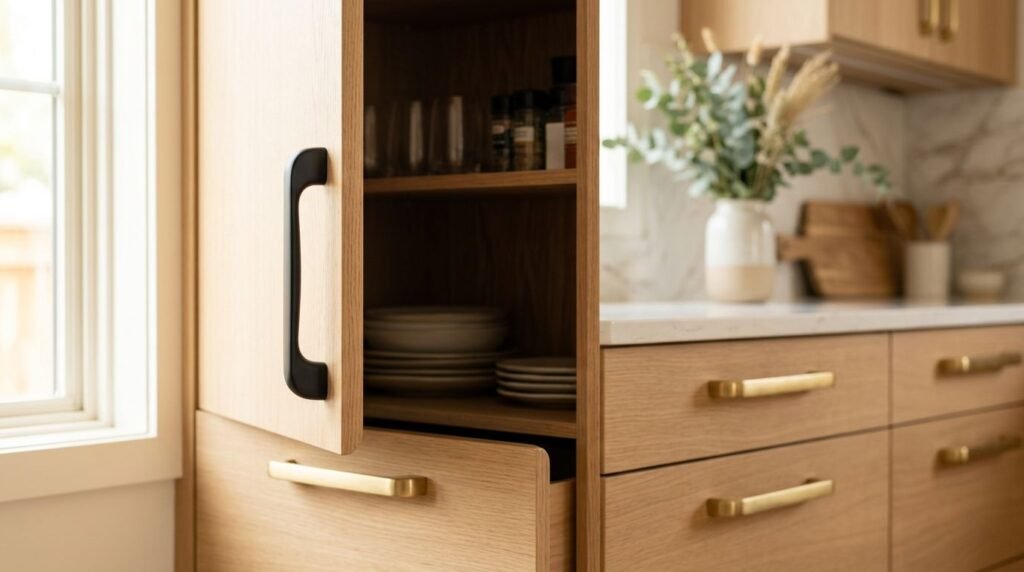
A cabinet door can become frustrating when opening it requires a tight pinch, a painful twist, or more strength than your hand can provide. The right aging-in-place cabinet hardware makes everyday storage easier to reach and operate without making your kitchen or bathroom look institutional.
Good hardware should fit your grip, your reach, and your cabinet design. Before choosing a finish or style, consider how you use each cabinet today and how your needs may change over time. Start with comfort, then refine the look.
Key Takeaways
- Pulls usually offer a more comfortable grip than small knobs, especially for people with arthritis or limited hand strength.
- Hardware placement matters as much as the hardware itself, particularly for tall doors, upper cabinets, and drawers.
- Rounded edges, strong contrast, and durable finishes support safer, easier daily use.
- Test hardware samples at home before drilling, and include accessibility goals in the cabinet planning stage.
Assess Your Needs Before Buying Hardware
Aging in place means creating a home that remains comfortable and usable as your mobility, strength, or balance changes. Cabinet hardware plays a small but frequent role in that goal. You may open a kitchen drawer dozens of times each day, so minor discomfort can become a constant irritation.
Begin by observing how you open cabinets now. Do you grip a knob with your fingertips, or can you wrap your whole hand around a pull? Does twisting a wrist cause pain? Can you comfortably reach an upper cabinet while standing, or would a lower drawer work better for frequently used items?
Your answers should guide the hardware style and cabinet layout. Someone with arthritis may prefer a long pull that allows several fingers to share the effort. Someone with reduced reach may benefit from hardware placed near the lower edge of an upper door. A person who often works from a seated position may need drawers and doors that open with minimal force.
Walk through the room and identify the storage you use most. In a kitchen, that may include the silverware drawer, cookware drawers, trash pull-out, refrigerator panels, and pantry. In a bathroom, focus on the vanity drawers, medicine storage, and linen cabinets.
A cabinet designer can help connect these observations to the broader plan. The cabinet knobs versus pulls guide offers a useful starting point when you want to compare grip styles for different cabinet locations.
You should also consider visibility. Hardware that contrasts with the cabinet color is easier to find, especially in low light. A dark pull against a pale door, or a light pull against a dark finish, can provide a clear visual target without changing the cabinet style.
Choose Cabinet Pulls for Grip and Control
For many aging-in-place kitchens, pulls are easier to use than knobs because they allow a larger hand contact area. You can pull with your fingers, palm, or the side of your hand instead of relying on a tight pinch.
Knobs still work well in certain locations. A large, rounded knob may suit a light cabinet door, particularly when it offers enough space for a comfortable grip. Small knobs, crystal shapes, and sharply edged designs are less practical when hand strength or finger control is limited.
Use this comparison when narrowing your options:
| Hardware type | Where it works well | Accessibility considerations |
|---|---|---|
| Bar pull | Drawers, base cabinets, pantry doors | Offers several gripping positions and good leverage |
| D-shaped pull | Most kitchen and bathroom cabinets | Rounded profile gives the hand a stable hold |
| Large knob | Light-use doors | Choose a size that doesn’t require a tight pinch |
| Cup pull | Decorative drawer fronts | Can require an underhand grip and more wrist movement |
| Touch latch | Minimalist doors | May require firm pushing and can be difficult for some users |
Bar pulls and D-shaped pulls are often practical choices because their open space gives your fingers room to wrap around the hardware. A pull with a smooth, rounded profile is usually more comfortable than one with a thin, square edge.
Length also affects control. A longer drawer pull can distribute force across the hand, which helps with heavy drawers holding pots, pans, or small appliances. However, oversized hardware may look out of proportion or create an obstacle in a narrow walkway. Match the pull to the drawer width and the clearance around it.
Cup pulls deserve a closer look before you choose them for every drawer. Their traditional appearance may suit a farmhouse or transitional cabinet design, but the required underhand motion can be difficult for people with wrist pain. Test one in person before committing to a full kitchen.
Avoid hardware with sharp corners, deep grooves, or rough textures that can catch clothing or irritate skin. A comfortable pull should feel secure without demanding extra effort.
Place Hardware Where It Feels Natural to Reach
The best hardware can still feel difficult if it sits too high, too low, or too close to a cabinet edge. Placement should support the way your hand approaches the door or drawer.
On a standard drawer, a centered horizontal pull is often easy to locate and use. Wide drawers may need a longer pull or two pulls, depending on the drawer size and the force needed to open it. For a heavy drawer, place your hands where they can pull straight toward your body rather than at an awkward angle.
Tall pantry doors and utility cabinets often work better with vertical pulls. A vertical orientation gives your hand a longer target and can reduce wrist rotation. The pull should remain within comfortable reach, with enough clearance from nearby walls, appliances, and adjacent doors.
Upper cabinet doors need special attention. Hardware placed near the bottom corner can be easier to reach than hardware near the center or top. Base cabinet doors may feel more natural with pulls placed toward the upper corner. The correct location depends on the door swing, your height, and whether you approach the cabinet from a standing or seated position.
Before drilling, apply painter’s tape to the cabinet face and mark several possible locations. Use a temporary sample or hold the actual hardware against the tape. Open the door repeatedly with your usual hand, then try it with the other hand. Test the same location while carrying a light item.
For detailed measurements and consistent spacing, use this guide to place cabinet hardware for easier reach. A consistent layout improves the room’s appearance, but comfort should decide the final position.
Check the clearance after installation. A pull that feels comfortable on a cabinet near the wall may become awkward when another door, appliance, or corner limits your approach. Good placement leaves enough room for your fingers and keeps the handle from striking nearby surfaces.
Match Finish, Contrast, and Cabinet Design
Hardware should support accessibility while fitting the visual character of your kitchen or bathroom. Fortunately, practical hardware comes in styles that suit traditional, transitional, contemporary, and modern cabinet design.
Finish affects visibility, cleaning, and long-term maintenance. Satin nickel and brushed stainless steel soften fingerprints and provide moderate contrast against many painted cabinets. Matte black offers strong contrast on light cabinetry, although it may show dust or water spots. Polished chrome reflects more light and can work well in bathrooms, but its shine may reveal fingerprints.
In a coastal area such as Southwest Florida, humidity and salt air deserve attention. Ask about the hardware’s base metal and finish process, especially for cabinets near a sink, dishwasher, or outdoor entertaining area. Solid brass, stainless steel, and well-finished metal options can offer better resistance to corrosion than low-grade plated hardware.
The guide to durable cabinet hardware finishes covers material and finish questions that matter in humid homes. Choose a finish that you can see clearly, clean without difficulty, and live with for years.
Contrast should remain part of the cabinet design conversation. If the hardware blends completely into the door, it may be harder to locate. Strong contrast isn’t required, but the handle should stand apart from the cabinet enough to provide a clear visual cue.
Coordinate the hardware with hinges, faucets, lighting, and appliances when possible. Matching every metal isn’t mandatory, yet too many unrelated finishes can make a room feel unsettled. A cabinet designer can create a cohesive combination while keeping the most frequently used hardware easy to identify.
Test Samples Before the Final Installation
Photos and showroom displays can’t show how a handle feels after repeated use. Before ordering every piece, test representative samples on a drawer and a door. Ask each person who uses the room to try them, including anyone with arthritis, reduced grip strength, or limited reach.
Pay attention to the motion required. Can you open the cabinet with a relaxed hand? Does the pull provide enough clearance for your fingers? Does the door move smoothly without forcing your wrist into an uncomfortable angle?
Hardware screws must fit the cabinet thickness and pull dimensions. A professional installer can use a drilling template to keep holes aligned, prevent chipped finishes, and maintain consistent spacing. Existing cabinets require extra care because misplaced holes are difficult to hide.
If you are ordering new cabinets, make hardware placement part of the design discussion rather than waiting until installation day. Mark the locations on the drawings, confirm the pull sizes, and request a sample when the hardware has an unusual shape.
Soft-close hinges and drawer guides can reduce the force needed to operate cabinets, but they don’t replace accessible hardware. The opening motion, hardware grip, and cabinet location all work together. A comfortable handle on an overstuffed drawer may still feel difficult to use.
Conclusion
Choosing cabinet hardware for aging in place starts with the way your hands, wrists, and reach work today. Pulls with rounded edges often provide better control, while thoughtful placement makes frequently used storage easier to find and open.
Test the hardware before installation, select a finish with enough contrast, and include accessibility in the cabinet design from the beginning. When a cabinet opens with a relaxed grip instead of a painful twist, the small decision at the door improves the entire room.