
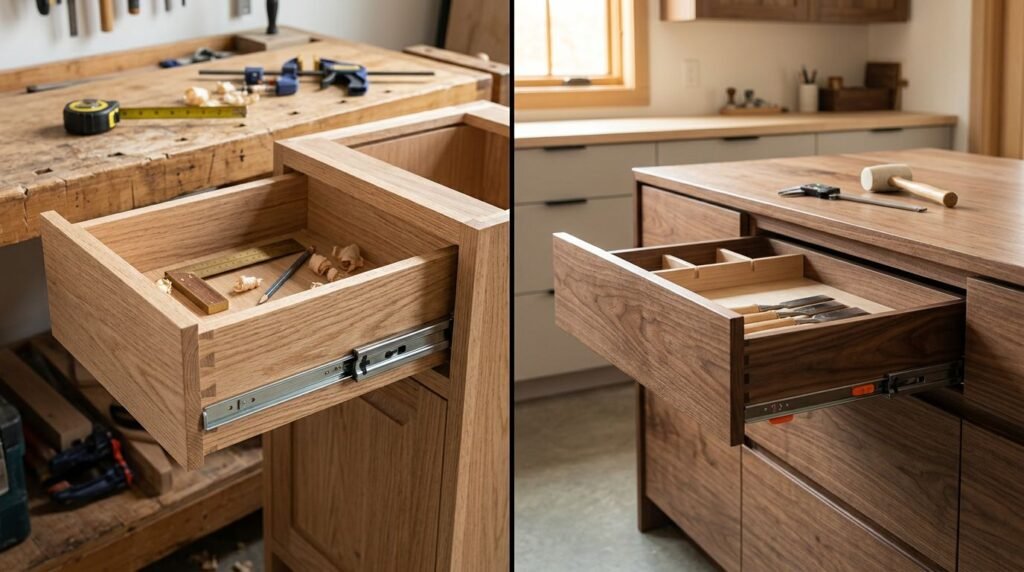
Drawer slides affect more than how smoothly a cabinet opens. They change usable drawer space, installation requirements, appearance, and the type of box you can build.
The choice between undermount vs. side-mount drawer slides should begin with your cabinet opening and drawer construction. Choose the slide first, then build the drawer around its specifications, not the other way around.
Key Takeaways
- Side-mount slides are practical, widely available, and easier to fit with standard drawer boxes.
- Undermount slides stay hidden and preserve drawer width, but they require more precise construction.
- Cabinet opening dimensions, drawer thickness, clearances, and slide specifications must match.
- Face-frame and frameless cabinets may need different brackets or mounting methods.
- Soft-close action is useful, but the slide’s load rating and compatibility matter more.
Start With the Drawer Box, Not the Slide
New cabinets give you a chance to plan the drawer system correctly. Begin by measuring the cabinet opening, then select a drawer box and slide combination that fits those measurements.
Measure the opening width at the front, middle, and rear. Use the smallest measurement if the cabinet sides aren’t perfectly parallel. Also record the opening height, available depth, and the position of hinges, shelves, and face-frame components.
The drawer’s outside width depends on the slide type. Many side-mount slides require about 1/2 inch of clearance on each side, but the exact amount belongs to the slide manufacturer. A drawer for a 21-inch opening might therefore be close to 20 inches wide with one common side-mount design. That calculation isn’t universal, so check the installation sheet before building the box.
Undermount slides use a different measurement system. They sit below the drawer rather than against its sides. The box may need a certain bottom thickness, bottom setback, rear clearance, or space for locking clips. Some models also require rear notches or specific drilling locations.
A side-mounted product isn’t automatically compatible with a drawer made for undermount hardware. Likewise, an undermount slide won’t fit every plywood or dovetail box. The slide, cabinet opening, and drawer box must be designed as one system.
Cabinet style also affects the installation. Frameless cabinets provide direct access to the cabinet sides. Face-frame cabinets may need front mounting brackets or rear supports, depending on the slide. The cabinet manufacturer and slide manufacturer should both identify the correct hardware.
Side-Mount Drawer Slides: Practical and Forgiving
Side-mount slides attach to the outside of the drawer and the inside of the cabinet. You can see them when the drawer is open, but they offer a familiar installation method for many cabinet makers and DIY renovators.
These slides work well with standard drawer boxes. You can use common construction methods, including plywood boxes with applied fronts, solid-wood boxes, and many dovetail designs. The important requirements are the slide’s side clearance, length, mounting height, and weight rating.
Installation is usually straightforward. The cabinet members must sit parallel, and both sides must remain at the same height. A small error can cause binding, uneven gaps, or a drawer that drifts open. A tape measure, square, level, and drill or driver are usually enough for a careful installation.
Side-mount slides also offer a broad range of sizes and capacities. Basic roller slides can suit light bathroom drawers. Ball-bearing slides provide more support for kitchen storage. Full-extension models allow the drawer to project far enough for you to reach the rear contents.
The tradeoff is lost interior width. The slides occupy space beside the drawer, so the usable drawer is narrower than the cabinet opening. The hardware also remains visible. That may be fine inside a utility cabinet, but it can distract from a polished cabinet design with premium drawer fronts.
Side-mount slides can be a strong choice when:
- The drawer box already has side-mount dimensions.
- You want a familiar installation process.
- Replacement hardware must be easy to find.
- The cabinet needs a high load rating at a reasonable cost.
- You don’t mind visible hardware inside the open drawer.
Check the manufacturer’s load rating with the drawer and contents included. A drawer filled with cast-iron cookware places more stress on the slides than an empty drawer, even when the box itself is strong.
Undermount Drawer Slides: Clean Lines and Tighter Requirements
Undermount slides attach beneath the drawer. When the drawer opens, the hardware stays mostly hidden, leaving a clean view of the box and cabinet interior.
This design can preserve more usable drawer width because the slide doesn’t occupy the side walls. It also pairs well with premium kitchens and bathrooms where the open drawer should look as finished as the closed cabinet front.
Many undermount systems include soft-close mechanisms and adjustable locking devices. These features can help align the drawer front and reduce slamming. However, soft-close action doesn’t make an incompatible drawer work. The box still needs the correct dimensions and mounting points.
Undermount slides demand more preparation than most side-mount models. The bottom of the drawer may need to sit at a prescribed height. The rear corners might require notches. Locking clips may need precise holes or a particular distance from the front. Some systems accept a specific box style, while others support a wider range of construction.
Read the complete installation drawing before ordering materials. Pay attention to:
- Required drawer width and side clearance
- Minimum and maximum drawer depth
- Drawer-bottom thickness and position
- Rear notch dimensions, if required
- Front locking clips and adjustment space
- Cabinet-side mounting brackets
- Weight capacity at the chosen slide length
A drawer maker who usually builds side-mounted boxes shouldn’t assume the same box will accept undermount hardware. Build a sample drawer or use the manufacturer’s box specifications before producing a full set.
Undermount slides make sense when:
- Hidden hardware is a major design priority.
- The drawer box can be built to the slide’s dimensions.
- You want maximum interior width.
- The project includes custom cabinet work and careful installation.
- The budget allows for more specialized hardware and labor.
For drawers in a humid coastal home, review the finish and corrosion guidance for the exact product. Soft-close performance is also worth comparing. These soft-close drawer slide recommendations can help when quiet operation matters in a kitchen or bathroom.
Which Slide Fits Your New Cabinet Design?
Neither mounting style wins every project. The right choice depends on how the cabinet will be built, used, and serviced.
| Decision factor | Side-mount slides | Undermount slides |
|---|---|---|
| Hardware visibility | Visible when the drawer opens | Mostly hidden |
| Drawer width | Reduced by required side clearance | Often provides more interior width |
| Box requirements | Works with many standard boxes | Usually needs a slide-specific box |
| Installation | Familiar and easier to adjust | More precise, with special clips or notches |
| Face-frame cabinets | May need brackets or adapters | May need frame brackets and rear support |
| Heavy storage | Available in high-capacity models | Capacity varies by model and box design |
| Replacement work | Often simple to source and replace | Must match the original system closely |
A homeowner ordering fully custom cabinets may prefer undermount slides because the cabinet maker can build each drawer box around the selected hardware. A DIY renovator using ready-made boxes may have fewer changes to make with side-mount slides.
Drawer size matters too. A narrow drawer benefits from every inch of interior width, so undermount hardware can be appealing. However, that benefit disappears if the drawer box does not meet the slide’s required clearance. A wide drawer filled with dishes needs a suitable load rating and stable mounting, regardless of where the slide sits.
Consider the cabinet’s position in the room. A bathroom vanity may need smooth, quiet movement for smaller drawers. A kitchen drawer holding pans needs suitable capacity and full extension. An outdoor entertainment cabinet needs hardware rated for its environment, along with a drawer box and finish suited to moisture exposure.
Your cabinet design should also account for the front overlay. The drawer front must align with nearby doors and other drawers. Mounting adjustments can help, but they cannot correct an opening that was measured incorrectly.
Verify Compatibility Before Ordering Hardware
A short planning check can prevent an expensive set of drawer boxes from becoming unusable. Follow the slide manufacturer’s drawing for every cabinet run.
- Measure the finished opening. Record width, height, depth, and any face-frame obstructions. Don’t rely on nominal cabinet sizes.
- Choose the drawer-box construction. Decide on plywood, solid wood, or dovetail construction before selecting the slide.
- Match the slide length. The slide must fit the usable cabinet depth without hitting the back panel or another component.
- Confirm clearances. Use the model’s published side, bottom, front, and rear requirements. Avoid applying measurements from another slide.
- Check the weight rating. Count the drawer box, front, hardware, and expected contents.
- Verify the cabinet style. Confirm whether you need face-frame brackets, rear sockets, spacers, or other supports.
- Build one test drawer. Install the hardware, check the gaps, and load the drawer before repeating the process.
During installation, mark each slide location from a consistent reference point. Keep the cabinet members parallel and level. For undermount systems, use the supplied drilling pattern or an appropriate installation jig. The clips and adjustment screws must engage fully before you load the drawer.
If a drawer feels tight, stop and measure again. Forcing it can bend the slide, damage the cabinet, or hide an incorrect box width. Check the opening, slide spacing, screw position, drawer depth, and mounting height in that order.
A cabinet professional can also confirm the specifications before production. This is especially useful when a project combines face-frame cabinets, frameless cabinets, wide drawers, and different drawer depths.
Conclusion
The choice between undermount and side-mount drawer slides comes down to the relationship between appearance, usable space, construction, and installation accuracy. Side-mount slides offer a practical fit for many standard boxes. Undermount slides provide hidden hardware and a refined look when the drawer is built to match.
Measure the cabinet opening first, select the drawer construction second, and confirm every clearance against the manufacturer’s specifications. When those parts align, the drawer will open smoothly because the entire cabinet design supports the hardware choice.