 Skip to content

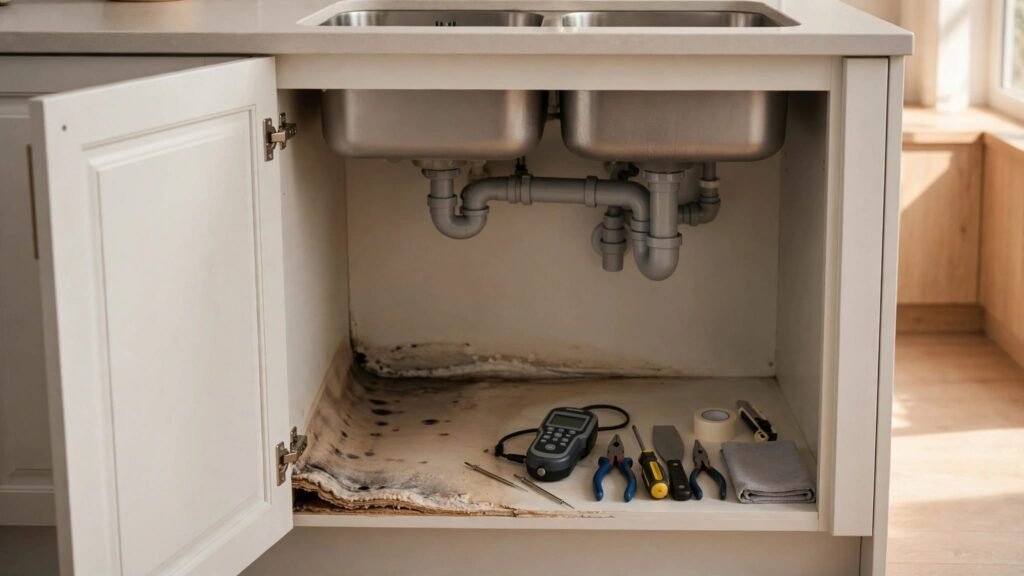
A kitchen leak can leave cabinet doors looking fine while water collects beneath the sink base. Your decision about water-damaged kitchen cabinets should start with structural condition, not the visible finish.
Surface damage may be repairable, but weakened boxes, swollen panels, and moisture behind cabinets need closer assessment. You don’t necessarily need an entirely new kitchen because one cabinet got wet.
First, stop the leak and address the moisture before deciding what can stay.
Stop the Leak Before Making Cabinet Decisions
Control the water safely
Shut off the affected fixture’s supply when you can reach the valve safely. If the source isn’t isolated, shutting off the home’s main water supply may be necessary. Remove stored items so you can see where water has collected.
Call a licensed plumber for damaged supply lines, drain failures, continuing leaks, or water emerging from a concealed area. A dishwasher connection, disposal, or shutoff valve may need attention.
Water near outlets, wiring, or appliances adds an electrical hazard. Avoid touching wet electrical equipment or reaching through standing water to unplug something. An electrician should assess affected electrical components.
Start drying without concealing damage
For a clean-water leak, remove standing water and wipe accessible surfaces once the area is safe. Open cabinet doors and remove loose shelves to expose wet surfaces. Conditioned air and a safely positioned dehumidifier can help reduce moisture.
However, a dry-looking cabinet interior doesn’t prove that the floor, wall, or cabinet back is dry. Enclosed areas may require professional drying and access behind the cabinetry.
Don’t direct fans across suspected mold or contaminated water. Sewage exposure, widespread wetting, and inaccessible moisture call for a restoration professional. Avoid painting, lining, or enclosing damp areas while the underlying condition remains unresolved.
Assess Visible and Hidden Cabinet Damage
Look beyond the doors and drawer fronts
Examine accessible cabinet bottoms, side panels, backs, toe kicks, and plumbing openings. Swelling often appears at raw edges before it becomes obvious on finished surfaces.
Watch for lifted veneer, peeling laminate, separated joints, sagging shelves, or fasteners that no longer hold securely. Doors that rub and drawers that bind can indicate movement, although alignment problems alone don’t establish water damage.
Also look at adjacent cabinets. Water can travel beneath a continuous toe kick or along flooring without leaving an obvious mark on every box.
A cabinet specialist should assess suspected structural damage. Stop using a cabinet that appears unstable, and avoid pulling out a sink base beneath a heavy countertop.
Take hidden moisture and mold signs seriously
A persistent musty odor, recurring dampness, staining behind a cabinet, or mold-like growth deserves investigation. These signs don’t establish the full extent of contamination, and an intact cabinet face can conceal damaged drywall.
Soft, swollen, or crumbly drywall and deteriorated backing also matter because cabinet mounting depends on sound support. New cabinets shouldn’t cover these conditions.
The U.S. Environmental Protection Agency notes that mold can penetrate porous materials and may be difficult to remove completely. Significant growth, concealed contamination, or health concerns warrant qualified assessment.
Avoid sanding or scraping suspicious growth. A restoration professional can address affected materials, while a cabinet professional assesses whether the remaining cabinetry is suitable for repair or reuse.
How Cabinet Materials Affect the Decision
Plywood and solid wood need different assessments
Quality plywood generally handles normal household moisture better than many lower-density wood-based panels. However, standing water can damage its layers, edges, and joints. Plywood construction doesn’t make a cabinet waterproof.
Separated layers, distortion, or weakened connections need assessment rather than a cosmetic cover-up. A plywood cabinet with limited surface damage may have different repair options than one with a deteriorated bottom panel.
Solid wood parts can expand, cup, or warp after wetting. Their condition after drying matters, especially where doors must fit accurately or joints carry weight.
Our comparison of plywood and MDF cabinet boxes explains why construction and edge protection matter alongside the material name.
MDF, particleboard, and coverings can hide damage
MDF provides a smooth surface for painted components, but prolonged wetting can cause swelling, especially at unfinished edges. Swollen MDF generally doesn’t return to its original dimensions simply because it dries.
Particleboard also deserves attention around leaks. Exposed edges can expand, and damaged material may lose its ability to hold screws securely.
Meanwhile, laminate or thermofoil can look intact over a weakened substrate. Replacing the covering won’t restore the material underneath.
Read component specifications rather than relying on labels such as “all wood.” Cabinet sides, bottoms, backs, doors, and drawer parts may use different materials, each with different vulnerabilities.
When Repair or Replacement Makes Sense
Repair is worth considering when damage is limited, the moisture source is resolved, and the cabinet remains structurally sound. Possible work includes refinishing a surface, replacing trim, or replacing an affected door.
Replacement becomes more relevant when damage affects the box’s strength, shape, connections, or ability to support hardware and countertops. The final scope depends on an on-site assessment.
Use these conditions to frame that discussion.
| Observed condition | Option to discuss |
|---|---|
| Surface mark on otherwise sound material | Local finish repair |
| Damaged door with an unaffected box | Door replacement |
| Swollen bottom or separated box joints | Component or cabinet replacement |
| Damage extending behind several units | Broader removal and restoration assessment |
The distinction is whether the proposed work restores function as well as appearance.
Refacing relies on sound cabinet boxes. New fronts cannot restore weakened joints or damaged screw-holding material.
Sometimes, replacing only the sink base is practical. However, matching dimensions, finish, door style, and adjoining panels can complicate a partial replacement. Existing finishes may also have changed color with age.
Countertop support is another constraint. Cabinet removal beneath stone countertops requires specialist planning and may affect the sink, plumbing, and backsplash.
Our cabinet installer questions help organize the construction and installation details that matter when comparing replacement options.
Budget for the Complete Project, Not Just Cabinets
A small repair and a replacement cabinet can involve different supporting work. Consider removal, drying, wall or floor repairs, plumbing disconnection, disposal, installation, and countertop handling.
A lower cabinet price doesn’t necessarily produce a lower total project cost. For example, replacing a sink base may still require several trades even when neighboring cabinets remain.
Keep damage-related work separate from optional upgrades. New storage accessories, a different layout, or additional cabinets can increase costs beyond restoring the affected area.
A written scope should distinguish cabinet installation from demolition and utility work. Old-cabinet removal isn’t always included in installation agreements. Our guide to planning kitchen cabinet removal covers these coordination issues.
For insurance documentation, photograph the leak source, affected cabinets, and exposed surrounding materials before repairs obscure the damage, when doing so is safe. Keep plumbing reports, drying records, receipts, and itemized estimates together.
Insurance considerations depend on the policy and circumstances of the loss. Separate the damage record from your wish list for improvements so the costs remain clear. Cabinet warranty terms are a separate matter and shouldn’t be treated as interchangeable with homeowners insurance.
Make Replacement Cabinetry Easier to Protect
Replacement is an opportunity to improve moisture protection without assuming any indoor cabinet is leak-proof. Prioritize sealed exposed edges, protected plumbing cutouts, sound joints, and accessible connections.
When comparing KraftMaid, Fieldstone Cabinetry, or Ultracraft, evaluate the selected collection’s construction details. Brand names alone don’t identify every box component or finish option.
A removable, non-structural back or toe kick can make future servicing less disruptive. Thoughtful cabinet access panels keep utility connections reachable without unnecessary demolition.
A sink-base tray and a leak sensor can also help reveal or contain small leaks before water spreads. However, neither replaces plumbing maintenance or makes the entire assembly waterproof. Our guidance on protecting sink base cabinets addresses the vulnerable areas around plumbing.
Before installation, repair the moisture source and affected wall or floor materials. In Southwest Florida, closing damp surfaces behind new cabinetry can leave a problem concealed.
We offer free consultations, 2-D and 3-D cabinet design options, and comprehensive quotes to help plan replacement cabinetry around your kitchen’s layout and practical needs.
Key Takeaways
- Stop the leak and address moisture before choosing a cosmetic repair.
- Assess cabinet boxes, mounting surfaces, and neighboring units, even when the doors look unaffected.
- Consider targeted repairs only where the remaining structure is sound; compare replacement options when panels, joints, or hardware support have deteriorated.
- Include restoration, removal, utilities, and countertop handling in the project scope.
Frequently Asked Questions
Can I paint over a water stain inside a cabinet?
Painting may be appropriate after the source is repaired, the material is dry, and the cabinet’s condition supports refinishing. However, paint won’t correct swelling, weakened joints, or hidden moisture. A stain accompanied by softness, recurring dampness, or mold-like growth needs assessment before refinishing.
Do all cabinets need replacement after a sink leak?
Damage may be limited to one unit, but water can spread beneath adjacent cabinets. The replacement scope depends on the affected boxes, surrounding materials, countertop support, and available matching components. An on-site assessment helps distinguish localized damage from a wider problem without assuming the whole kitchen must go.
Who should assess cabinets after a kitchen leak?
A plumber handles the water source. A restoration professional addresses extensive moisture or suspected contamination, while a cabinet specialist evaluates the cabinetry and replacement fit. Electrical hazards and heavy countertop removal need the appropriate qualified trades. Those roles address different parts of the same project.
Choose Sound Cabinetry Before a Fresh Finish
The right decision starts with sound structure and a resolved moisture problem. A cabinet that looks acceptable may still need attention beneath its finish.
Repair can preserve unaffected cabinetry when the underlying material remains suitable. Replacement makes more sense when damage prevents reliable support, fit, or function.
A fresh finish belongs on a cabinet worth keeping, after the leak and its hidden effects have been addressed.
