
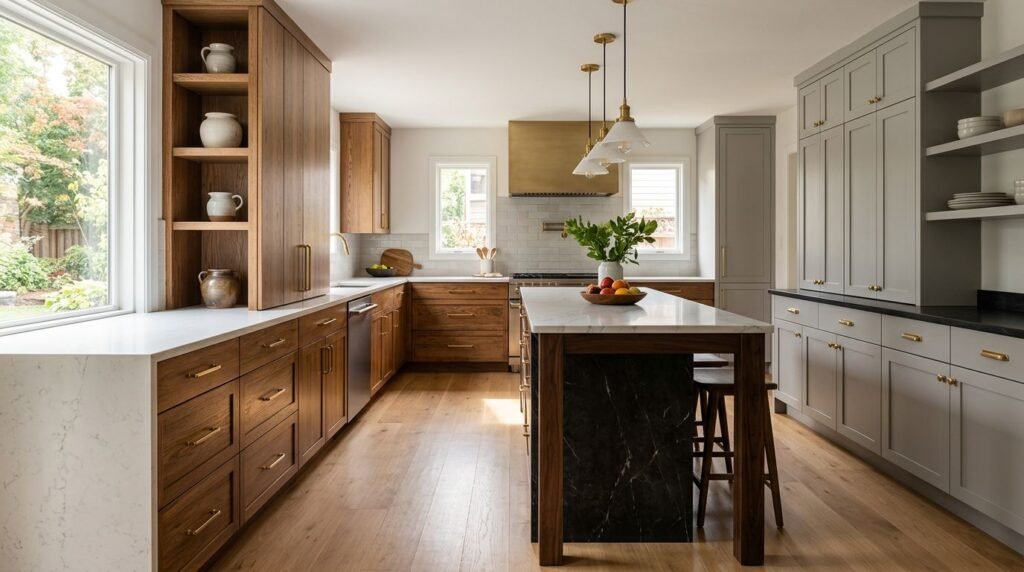
Kitchen remodeling budgets feel tighter in 2026, and cabinets are often the first place you notice it. Between labor pressure, material costs, and tariff-driven price jumps on imported wood cabinetry, the kitchen cabinets cost can climb faster than expected.
That doesn’t mean you need to trim every upgrade. It means you need a sharper eye for what lasts, what gets used daily, and what you can scale back without regretting it six months later.
The smartest cabinet budget is part structure, part style, and part restraint. Get that balance right, and your kitchen can look custom without draining the rest of the remodel.
What cabinet prices look like in 2026
Cabinet pricing in 2026 has a wider spread than many homeowners expect. Stock cabinets often land between $100 and $400 per linear foot installed, semi-custom cabinets often run from $150 to $700 per linear foot, and custom cabinetry can push past $1,200 per linear foot when the project calls for premium materials or specialty details.
Here is a quick snapshot of how the numbers usually stack up.
| Cabinet tier | Typical 2026 installed cost | Best fit | Common tradeoff |
|---|---|---|---|
| Stock | $3,000 to $8,000 for many smaller kitchens | Fast remodels, tighter budgets | Limited sizes and finishes |
| Semi-custom | $15,000 to $35,000 | Most mid-range kitchen remodels | More choice, higher cost |
| Custom | $15,000 to $50,000+ | Unique layouts, luxury finishes | Higher labor and lead times |
Tariffs on imported wooden cabinets have also pushed some buyers toward domestic products. That matters because pricing pressure is not only about material, it also shows up in freight, lead times, and what your installer can actually get on schedule.
Labor adds another layer. Installation can run from about $100 to $650 per linear foot, depending on complexity, demolition, wall corrections, and how much site work the job needs. A simple swap is one thing. A full rework around uneven walls, plumbing changes, or appliance panels is another.
The big takeaway is simple. In 2026, the cabinet box, the finish, and the install all affect the total more than door style alone.
Where splurging pays off
Spend where the cabinets take daily abuse. Doors can be replaced later. Boxes, drawers, and hardware do the heavy lifting for years.
The strongest places to splurge are the parts that affect durability and function:
- Cabinet boxes: Plywood boxes, stronger joinery, and moisture-resistant materials make sense, especially in humid climates.
- Drawer hardware: Full-extension, soft-close slides and sturdy glides matter more than decorative details.
- Hinges and pulls: Better hardware feels smoother every day and usually lasts longer.
- Custom fit around appliances: Tight clearances, filler management, and true alignment make a kitchen feel finished.
- Deep storage in high-use zones: Trash pull-outs, drawer stacks, and tray storage often earn their keep.
A good cabinet budget often starts with the inside, then works outward. That order keeps the kitchen practical before it gets pretty.
Spend where your hands go every day, and save where the eye only lands for a second.
This is also where cabinet design starts to matter. A well-planned drawer stack near the range can save more time than a fancy finish ever will. In a busy kitchen, that kind of efficiency is worth the money.
If your layout is complex, splurging on better measurements and planning is smart too. Mistakes in size or spacing cost more to fix than a stronger hinge ever will. For homeowners comparing standard layouts, standard kitchen cabinet dimensions are a useful starting point before you pay for custom work.
Where you can save without regretting it
The easiest savings usually come from choices people notice less after move-in. That is where cabinet refacing, stock, and semi-custom options can do a lot of work.
If your layout already functions well, affordable stock kitchen cabinets can be a smart base. Good cabinet design can make stock units look far more tailored than people expect, especially when the layout is clean and the finish is consistent.
The safest places to save are these:
- Standard sizes: Use common widths and heights when they fit the room. Custom sizing should solve a problem, not create one.
- Decorative panels: End panels, applied moldings, and extra trim can look nice, but they add up fast.
- Glass doors: They work well in small doses, yet full runs of glass often feel busy and cost more.
- Exotic finishes: A simple, durable painted or wood-look finish often ages better than a trendy color that loses appeal.
- Rare accessories: Fancy inserts, specialty dividers, and unusual pull-outs can be skipped unless you know you will use them often.
This is also where stock cabinetry has real value. If the sizes work and the finish suits the room, you can put the money into better counters, lighting, or a backsplash instead.
The same logic applies in bathrooms and laundry rooms. Save on visible extras when the cabinet will not take the same daily beating as a kitchen island or base run.
Cabinet design choices that change the budget fastest
Some decisions move the budget more than others, even when the cabinet line stays the same.
Layout changes are usually the biggest budget swing. Moving plumbing, shifting appliances, or reworking wall runs changes both cabinet count and labor. A kitchen that keeps its footprint intact often gives you more room to spend on quality construction.
Finish choices matter next. Warm wood tones, two-tone kitchens, and deeper colors are popular in 2026, but those looks can cost more if they require special coatings, extra prep, or multiple finishes. A simple painted run with a wood island can capture the trend without paying for an all-in custom package.
Storage upgrades are another pressure point. Pull-out pantry systems, tray dividers, spice pull-outs, and panel-ready appliance fronts add convenience, but they can also eat a big slice of the budget. Pick the features you’ll use every day, then stop there.
For homeowners who want a polished result without overbuying, the best sequence is often this: fix the layout, choose reliable cabinet construction, then layer in one or two upgrades that change the daily experience. That keeps cabinet design grounded in use, not just appearance.
A practical split for different remodel goals
A useful cabinet budget in 2026 depends on what you’re changing. The right splurge in one kitchen is wasted money in another.
If your kitchen already works, put most of the money into cabinet construction and installation. A simple, durable cabinet line with strong hardware can look sharp when the fit is clean and the finish is consistent.
If you are changing the layout, reserve more for design and labor. In that case, the price jump usually comes from measurement, leveling, fillers, and appliance integration, not just the cabinet boxes themselves.
If the kitchen is a main gathering spot, spend on the visible zones first. That usually means the island, sink base, and the wall you see when you walk in. Save on upper cabinets at the edges of the room and on decorative extras that don’t affect daily use.
A practical budget split often looks like this:
- Core structure and installation: the biggest share, because these are the parts that have to hold up.
- Function upgrades: drawers, pull-outs, and hardware that improve daily use.
- Visual upgrades: finish, trim, and statement pieces that shape the final look.
The exact percentages will shift with your project, but the order should stay the same. Protect the parts you touch most, then build the style around them.
Conclusion
Cabinet budgets feel easier to manage when you separate what lasts from what can be simplified. In 2026, that distinction matters even more because pricing pressure is real and imported products are less predictable.
If you want the best value, splurge on structure, hardware, and layout planning. Save on decorative extras, rare accessories, and custom features that do not solve an everyday problem.
A cabinet plan that fits the room, the household, and the budget will age better than a kitchen built around a trend. That is the kind of cabinet design decision that still makes sense years later.