
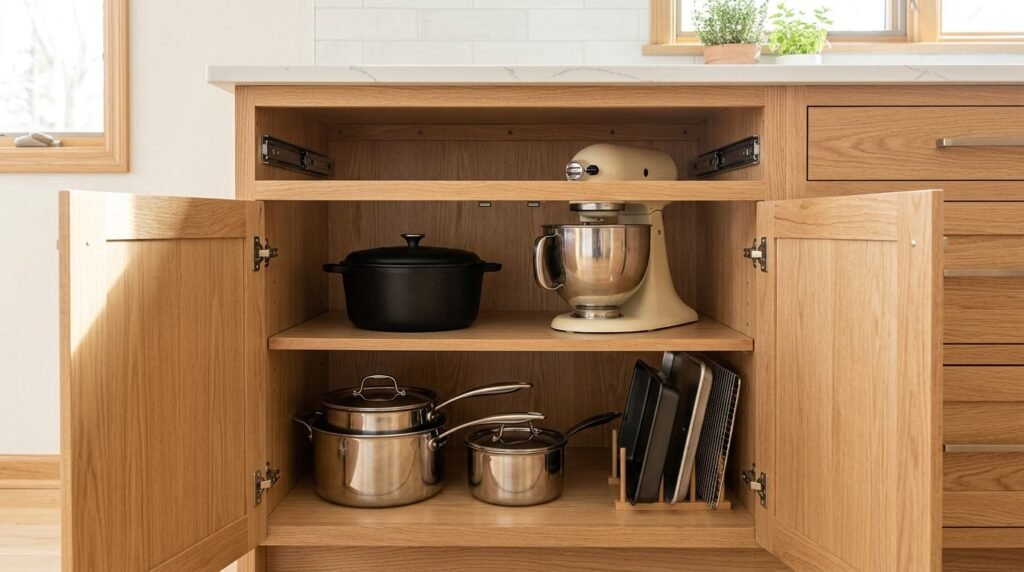
A cabinet can look generous on a plan yet fail the moment you try to store a Dutch oven or stand mixer. Accurate cabinet interior dimensions turn handsome cabinetry into storage that works every day.
Nominal cabinet sizes describe the outside of the box. What matters for storage is the clear space inside, after face frames, drawer hardware, shelves, doors, and back panels take their share. Start with the items you own, then plan the cabinet around them.
Measure the Space You Can Actually Use
Take measurements inside the finished cabinet opening, not across the outside cabinet width. A 30-inch base cabinet does not provide 30 inches of clear storage.
Check usable width, depth, and height
Measure usable width from the inside edge of one cabinet side to the other. For a framed cabinet, also account for the face frame that narrows the opening. If you are measuring a drawer, measure between the drawer sides rather than the cabinet walls.
Measure usable depth from the inside of the cabinet door or drawer front to the back panel. A standard 24-inch-deep base cabinet often has about 21 to 22 inches of interior depth. Drawer boxes may offer less because slides, the back panel, and construction details take room.
Finally, measure usable height between shelves, from the drawer bottom to the top edge, or from the cabinet floor to a shelf. Do this after shelf supports are in place. Those small metal clips or wood cleats can block a pot handle or appliance base.
For a broader view of standard box sizes, review this kitchen cabinet measurements guide. It helps separate exterior cabinet dimensions from the space your belongings will occupy.
Measure the largest item at its widest point, including pot handles, appliance feet, lids, and cords.
Cabinet Interior Dimensions for Large Pots
Large cookware is heavy, awkward, and often stacked too high in traditional base cabinets. Deep drawers bring pots forward and reduce bending, while shelves work best when the opening is wide and easy to reach.
Choose drawer widths that suit cookware
A 30-inch or 36-inch drawer base is a practical starting point for pots and pans. Aim for at least 24 inches of usable drawer width for a large skillet, Dutch oven, or stockpot. A 36-inch base often provides roughly 30 to 32 inches inside the drawer, depending on cabinet construction.
For depth, 20 to 22 usable inches handles most cookware. Plan for 9 to 12 inches of interior drawer height for everyday pots. Reserve 12 to 14 inches for tall stockpots or cookware stored with lids on.
Wide drawers also need durable slides and a sensible weight rating. Cast iron, filled cookware, and stacks of bakeware add up quickly. Put the heaviest pieces in the lowest drawer, where they are safer and easier to lift.
Leave room for lids and handles
A pot may fit inside a drawer but still catch on the top edge when its handles sit high. Measure the pot with its lid in place if you prefer to store it assembled. Otherwise, install a lid organizer inside the drawer or use a nearby vertical divider.
Cabinet doors require clearance, too. A pull or knob can hit an adjacent drawer front, wall, or appliance handle if the layout is tight. Door swing matters near dishwashers, ovens, and corner cabinets, especially when several doors may open at once.
For compact layouts, space-saving kitchen cabinet storage can help you prioritize deep drawers, vertical dividers, and pull-outs instead of unreachable back corners.
Size Cabinets for Small Appliances Before Ordering
Small appliances vary more than cookware. A toaster may need modest height but considerable depth, while a stand mixer can be tall and heavy. Measure every appliance you want off the counter, including any base, handle, lid, or cord plug.
Plan an appliance garage with breathing room
An appliance garage or dedicated counter cabinet usually needs 18 to 22 inches of usable depth for common countertop appliances. However, depth alone is not enough. Check the appliance manual for required airflow and use clearances.
A stand mixer often needs about 15 to 17 inches of clear interior height, depending on its model and bowl-lift position. Blenders may need 18 inches or more with the jar in place. Coffee makers need enough vertical space to fill the water reservoir, while air fryers and toaster ovens may need open space around them during use.
Manufacturer specifications take priority, especially for heat-producing appliances. Do not assume a closed cabinet is safe for a toaster oven, air fryer, microwave, or coffee maker. Some appliances must sit in the open while operating. Others need stated side, rear, and top ventilation clearances.
Account for cords, plugs, and access
A power cord can add several inches behind an appliance. If an outlet sits inside the cabinet, leave room for the plug without sharply bending the cord or forcing the appliance forward.
Plan the outlet and cord route early. A cabinet opening should allow the door to open fully without pinching the cord. If a roll-up or lift-up door is part of the design, confirm that its track and hardware do not reduce usable height or depth.
Never cut vents into a cabinet door, side, or back panel unless the appliance manufacturer approves that exact ventilation arrangement.
Match Storage to Your Daily Routine
Good cabinet design starts with what you use most. Keep frequently used pots near the cooktop, but leave enough aisle space to open a deep drawer without blocking traffic. A 42-inch work aisle is comfortable for one cook, while 48 inches gives two people more room.
Place small appliances near an outlet and a usable landing space. A heavy mixer is easier to use in a lower pull-out shelf or a counter-level cabinet. Meanwhile, an occasional-use slow cooker can live in a higher pantry section if the shelf has enough depth and support.
Use this quick planning guide before finalizing cabinet interior dimensions:
| Item | Practical interior target |
|---|---|
| Large pot drawer | 24 to 32 inches wide, 20 to 22 inches deep, 9 to 14 inches high |
| Base cabinet shelf | About 21 to 22 inches usable depth |
| Stand mixer cabinet | 15 to 17 inches clear height, plus room for the cord |
| Appliance garage | 18 to 22 inches usable depth, ventilation per manufacturer |
| Vertical lid storage | 4 to 6 inches wide, sized to lid handles |
For cabinets, appliances, and traffic to work together, planning a functional cabinet layout should happen before final selections and installation.
Final Thoughts on Storage That Fits
The best storage begins with real measurements, not assumptions based on cabinet labels. Measure the usable interior space, then add clearance for handles, lids, cords, shelf supports, ventilation, and door movement.
When cabinet interior dimensions match the cookware and appliances you use, counters stay clearer and daily cooking feels easier.