
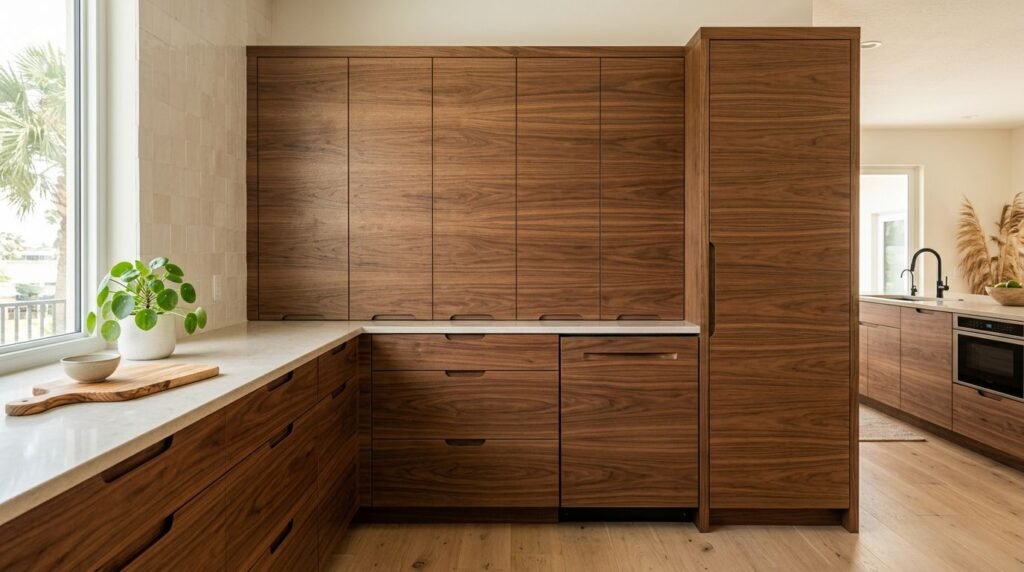
A beautiful wood kitchen can lose its calm when every cabinet door points in a different direction. Cabinet door grain matching keeps the movement of natural wood intentional, so doors, drawers, islands, and tall panels read as one design.
For Fort Myers homeowners, the decision involves more than choosing a stain. Wood species, veneer layout, door construction, finish, sunlight, and daily maintenance all affect the final result. This Fort Myers kitchen cabinet guide can help with the broader material and layout decisions. First, it helps to understand what grain matching can and cannot do.
What Cabinet Door Grain Matching Means
Grain matching aligns the visible pattern in wood across nearby cabinet parts. The goal is a controlled visual flow, not identical color on every door.
Natural wood still varies. One door may show a darker streak, a wider cathedral pattern, or more open pores than the door beside it. A good match places those differences in a way that feels balanced.
Grain direction is different from color matching
When a cabinet maker matches grain, they study the direction and shape of the wood fibers. They may align long lines across a row of slab doors or arrange veneer leaves in a planned sequence.
Color matching is a separate concern. Even doors made from the same species can accept stain differently. Cherry can deepen with light exposure, while white oak may show strong differences between boards. A finish sample helps, but it can’t remove natural variation.
Large surfaces attract the most attention
Grain matching is easiest to notice on wide, uninterrupted areas. These include:
- Slab doors and drawer fronts
- Island end panels
- Tall pantry doors
- Appliance panels
- Range hood surrounds
- Full-height cabinet sides
A small upper door may not need the same level of matching as a six-foot island panel. Many homeowners choose a stronger match in these focal areas and a more relaxed arrangement elsewhere.
Choosing cabinet door grain matching options
Several matching methods can create different visual effects. Availability depends on the cabinet brand, wood species, door style, and whether the face uses veneer or solid wood.
| Matching option | Visual effect | Best fit |
|---|---|---|
| Random or standard | Natural variation across each door | Traditional kitchens and lower-contrast layouts |
| Sequence matching | Grain flows across neighboring doors | Long runs of slab doors and broad panels |
| Bookmatching | Two veneer leaves mirror each other | Feature panels and formal focal points |
| Slip matching | Parallel leaves repeat in the same direction | Straight-grain designs with a calm, regular look |
Random matching keeps the room relaxed
Random matching doesn’t mean careless construction. Each door still receives an appropriate veneer or wood piece, but the grain doesn’t continue from one door to the next.
This approach works well when you want the room to feel casual and organic. It can also suit raised-panel or detailed door styles, where rails, stiles, and profiles already interrupt the pattern.
Because each door has its own character, random matching may be more forgiving when the kitchen includes several sizes. You won’t expect a narrow drawer front to continue a pattern from a much wider door.
Sequence matching creates a continuous flow
With sequence matching, adjacent veneer leaves stay in order. The grain can move across a group of doors or panels with fewer abrupt changes.
This option often suits flat-panel slab doors because the broad faces give the pattern room to continue. It can also make a tall pantry wall look more unified.
Sequence matching requires careful planning. The cabinet order, door sizes, drawer placement, and panel locations all matter. If the layout changes after production, the original sequence may no longer work as planned.
Bookmatching makes a deliberate statement
Bookmatching places two adjacent veneer leaves beside each other as mirror images. The center seam can create a strong symmetrical effect.
This look fits a range hood surround, island end, or another feature panel. However, it can feel too formal when used across an entire kitchen. It also doesn’t suit every door construction, especially when rails and stiles interrupt the center panel.
Ask to see a sample of the actual species and finish. A bookmatched walnut panel will look very different from a bookmatched white oak panel.
How wood species changes the grain result
The same matching method can look subtle on maple and dramatic on walnut. Choose the species before you decide how much visual continuity you want.
White oak highlights natural movement
White oak has visible pores and a distinct grain pattern. It works well with clear coats, light stains, and warm neutral finishes. Rift-sawn white oak typically shows straighter lines, while other cuts can reveal more variation and fleck.
For a light Fort Myers kitchen, white oak kitchen cabinets can support a calm, natural look without requiring every door to match perfectly. A matte clear finish keeps the wood character visible. A darker stain creates more contrast between the grain lines and surrounding wood.
Because white oak has a noticeable pattern, sequence matching can look polished on a long wall. Random matching can feel more relaxed and may highlight the natural differences between doors.
Maple offers a quieter pattern
Maple usually has a fine, restrained grain. That makes it a practical choice when you want a smooth appearance or a painted finish.
Under a clear finish, maple can look clean and light. With stain, it may show subtle variation rather than bold movement. Its quieter surface also makes it easier to combine with a patterned backsplash, veined countertop, or decorative hardware.
Walnut, cherry, and alder create different levels of contrast
Walnut often has rich color and noticeable variation. Bookmatching can create a dramatic feature, while random placement gives it a more natural appearance.
Cherry has a warm tone that can change over time with light exposure. If you need a close match to existing cherry cabinetry, compare newer and older samples before ordering replacement doors.
Alder has a softer, less uniform appearance. It can suit traditional or transitional kitchens, especially when you want stain variation without the stronger contrast of oak or walnut.
Cabinet lines don’t all offer the same species, cuts, or matching services. A Fort Myers cabinet brand guide can help you compare available construction, door materials, finishes, and design flexibility.
Door construction sets the matching limits
Grain matching must follow the way a cabinet door is built. A designer can’t make a framed door behave like one uninterrupted wood sheet.
Slab doors show grain continuity clearly
A slab door has a broad, flat face. When it uses veneer, the grain can run in one direction across the entire front. That makes sequence matching and bookmatching easier to see.
Ask whether the door face uses solid wood, natural veneer, or a veneer over an engineered core. Each option affects movement, pattern consistency, edge details, and repair expectations.
Slab doors also expose alignment issues. Small differences in grain direction can stand out across a long row, especially with a clear or lightly tinted finish.
Shaker doors divide the pattern
A Shaker door has separate rails, stiles, and a center panel. The grain may run vertically on the stiles and horizontally across the rails. The center panel can have its own direction.
As a result, grain matching usually focuses on the center panels and drawer fronts. The grain won’t flow continuously through every corner, and it shouldn’t. That construction is part of the door’s character.
Slim Shaker doors place more attention on the center panel because the rails and stiles are narrower. A wider Shaker profile can make natural variation feel less prominent.
Finish changes how much grain you see
The finish controls contrast, sheen, and the way light moves across the cabinet surface. Two doors made from the same wood can look unrelated if they receive different finishes.
Clear coats and stains reveal the pattern
A clear finish preserves much of the wood’s original appearance. It allows grain direction, pores, knots, and color shifts to remain visible.
Stain changes the balance. Darker stains often increase contrast between the grain and the surrounding wood. Lighter stains keep the result softer but may still reveal differences between boards.
Wire-brushed or textured finishes make the surface pattern more pronounced. They can work well with rustic or coastal styles, but they may also make mismatched grain easier to notice.
Paint hides most grain variation
Painted maple, MDF, or HDF doors provide a more consistent color field. The underlying wood pattern becomes far less important, although door profiles and panel proportions still affect the design.
Paint can also make a two-tone kitchen easier to coordinate. For example, painted perimeter cabinets can pair with a natural wood island without requiring a perfect grain match across the entire room.
Always review a full-size door sample under the lighting in your kitchen. A small sample card can’t show how a finish looks across rails, panels, edges, and wide drawer fronts.
Fort Myers conditions call for careful material choices
Fort Myers kitchens experience changing indoor conditions, strong daylight, cooking heat, cleaning, and regular contact with water near sinks and dishwashers. These factors don’t guarantee failure or success for any single material. Construction quality, sealing, installation, and care matter more than a simple location label.
Sealed edges protect the finished appearance
Water that reaches an unfinished edge can cause problems for many wood-based materials. Sink bases, dishwasher openings, and areas near plumbing deserve close attention during specification and installation.
Ask how the cabinet doors, panels, and exposed edges receive their finish. Also ask which cabinet box material fits the room and the manufacturer’s care requirements. This guide to humidity-resistant cabinets provides useful comparisons without treating any cabinet as climate-proof.
A level, plumb installation helps doors remain aligned. Proper hinge adjustment also protects the grain pattern because uneven gaps can distract from an otherwise consistent layout.
Maintenance preserves the finish
Wipe spills instead of allowing water to sit on a door or panel. Use a soft, slightly damp cloth and follow the cabinet maker’s cleaning instructions. Abrasive pads, harsh solvents, and excess water can damage the finish.
Sunlight may change the appearance of natural wood over time. Window coverings can reduce direct exposure, but different woods and finishes respond differently. Ask for care instructions before selecting a finish for a bright kitchen.
How to choose the right matching level
Start with the parts that matter most to you. Some homeowners want a calm, continuous island face. Others prefer the variation that makes each wood door look individual.
Decide where consistency matters most
A practical cabinet design gives priority to the areas that draw attention. You might request sequence matching across an island while using standard matching on the perimeter. Another option is to reserve a bookmatched panel for a hood or tall cabinet wall.
Before ordering, review the complete elevation or rendering. Confirm the direction of the grain on doors, drawers, end panels, and appliance panels. Check whether the designer has specified horizontal or vertical grain where the door style allows a choice.
If you’re replacing only a few doors, compare them against the existing cabinetry in daylight and evening light. Older wood may have changed color, so an exact match may be unrealistic. A deliberate contrast can look better than a near match that appears accidental.
Balance the look against the budget
More controlled matching can involve additional veneer selection, layout planning, and material. The final price also depends on the cabinet line, door style, box construction, finish, hardware, and installation conditions.
Semi-custom cabinetry may offer several wood species and finish choices without the full cost of a completely tailored order. Custom work can make more sense for unusual dimensions, large feature panels, or a layout that needs specific grain placement. Compare custom versus semi-custom cabinets before deciding how much personalization your project needs.
Put the matching plan in writing. The quote should identify the wood species, door style, finish, sheen, matching method, and areas that receive special treatment. It should also state that natural color variation remains part of real wood.
Conclusion
Cabinet door grain matching gives natural wood a planned appearance, but it doesn’t make every door identical. Sequence matching creates continuity, bookmatching adds symmetry, slip matching keeps lines parallel, and standard placement preserves a more relaxed look.
The best choice depends on the wood species, door construction, finish, room layout, and the areas you want to highlight. Review a full-size sample, discuss exposed edges and installation, and choose a matching level that fits both your style and budget. In a Fort Myers kitchen, intentional variation often creates a warmer result than chasing perfect uniformity.