
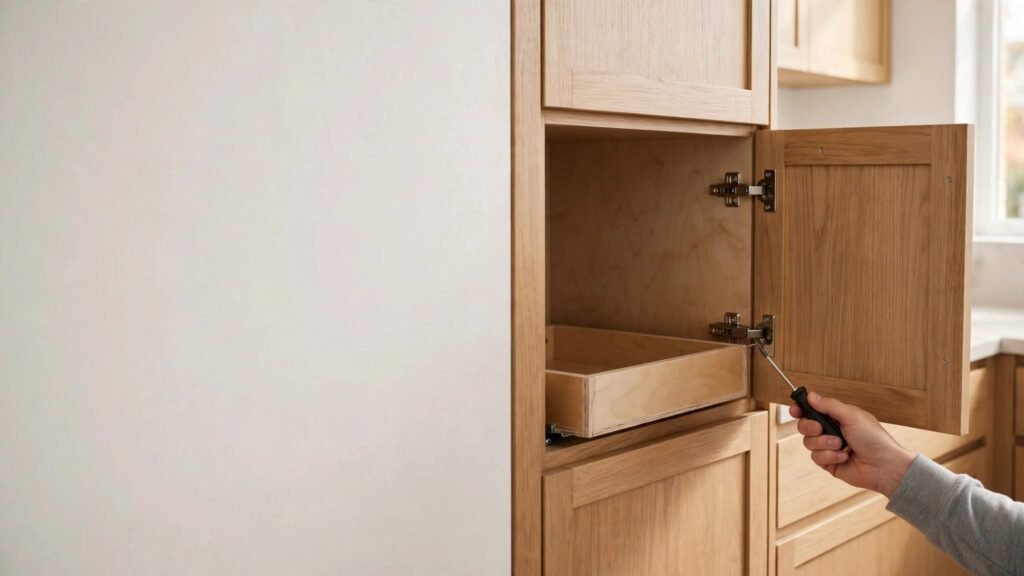
A crooked cabinet door can make an otherwise beautiful kitchen or bathroom feel unfinished. Learning how to adjust concealed cabinet hinges helps you correct small shifts without replacing the door or hardware.
The right adjustment depends on the hinge model, cabinet construction, and overlay style. Work slowly, support heavier doors, and check the door after every small change. Before touching a screw, confirm that the cabinet box itself is level, secure, and square.
Key Takeaways
- Concealed hinges commonly allow side-to-side, height, and depth adjustments, but designs vary by manufacturer.
- A loose, leaning, or twisted cabinet box can make hinge adjustments ineffective.
- Identify whether the cabinet is framed or frameless before changing the hinge position.
- Adjust one hinge at a time, using small movements and checking the entire door after each change.
- Tighten loose mounting hardware before correcting the door position.
- If a tall or heavy door continues to sag, it may need a third hinge or professional correction.
- Soft-close hinges work best when the door is aligned and free from rubbing.
Check the Cabinet Before Adjusting the Hinges
Hinges can correct a small shift in the door. They can’t correct a cabinet box that rocks, pulls away from the wall, or sits out of square.
Open the door and apply gentle pressure to the cabinet side. The box should remain firm. Check that base cabinets sit securely on the floor and that wall cabinets are anchored properly. A loose cabinet can cause the door to move out of alignment again after every adjustment.
Look across the full cabinet run, not only at the problem door. Compare the top edges, bottom edges, and spaces between nearby fronts. If one door is slightly off while the boxes around it remain stable, hinge adjustment may solve the issue. If an entire row slopes or the gaps change across several cabinets, ask the installer to correct the installation first.
Identify the cabinet construction
On framed cabinets, the hinge mounting plate attaches to the face frame. On frameless cabinets, the plate usually mounts to the cabinet box side. That difference affects where you make a height adjustment and which replacement parts will fit.
For a clearer comparison, review how cabinet construction affects hinge adjustment. The cabinet structure matters when you are buying new cabinetry because serviceable, adjustable hardware makes future alignment easier.
Check the overlay and door spacing
Overlay describes how much the door covers the cabinet frame or box. Full overlay doors leave less frame visible, while partial overlay doors show more of the cabinet structure. Inset doors sit inside the opening and require tighter, more precise spacing.
Your cabinet design affects the visible reveals, hinge compatibility, and amount of room around neighboring doors. Review full overlay, partial overlay, and inset cabinets before replacing hinges or doors. Never order hardware based only on the phrase “full overlay.” The hinge crank, mounting plate, cabinet construction, and opening angle also matter.
Learn What Each Hinge Adjustment Changes
Most modern concealed hinges provide three adjustment directions. Some models combine these adjustments differently, so check the manufacturer’s instructions before turning a screw.
Side-to-side adjustment
Side-to-side adjustment moves the door left or right. Use it when the center gap between paired doors is too wide, too narrow, or uneven.
It can also help align the edge of one door with the neighboring door. Adjust the top and bottom hinges gradually rather than forcing one hinge to correct the entire front. After each change, close the door and compare the gap from top to bottom.
Height adjustment
Height adjustment raises or lowers the door. On many hinges, you make this correction by loosening the screws that hold the mounting plate, sliding the door carefully, and tightening the screws again.
Support the door while loosening anything. A tall or heavy front can shift suddenly and place extra stress on the hinge or cabinet box. If the door drops as soon as you loosen the plate, stop and ask for help.
Depth adjustment
Depth adjustment moves the door toward or away from the cabinet box. Use it when the door sits proud of the neighboring fronts, rubs against the cabinet frame, or doesn’t sit evenly when closed.
A depth correction can also affect the soft-close action. If the door sits too far forward or presses against another front, the damper may struggle to pull it closed smoothly.
How to Adjust Concealed Cabinet Hinges Safely
You don’t need to remove the door for most minor corrections. A screwdriver that fits the hinge screw head, good lighting, and a stable stance are usually enough for an installed door.
Make one small change at a time
Start with the hinge closest to the area that looks misaligned. Turn or loosen only the adjustment specified by the manufacturer. Avoid treating every visible screw as an adjustment screw because some screws only secure the hinge.
Make a small change, then close the door gently. Check the top, bottom, hinge-side, and handle-side gaps. Large changes can shift the door suddenly and create a second problem elsewhere.
If a screw feels stripped, unusually tight, or loose without moving the door, stop. Continuing can damage the hinge, screw head, or cabinet material.
Check the full door after every change
Open and close the door several times. Look for rubbing, binding, springing open, or a gap that widens toward one corner. Compare the door with adjacent fronts instead of judging it alone.
A door can appear straight by itself but look uneven across a long cabinet wall. This matters especially with full overlay cabinetry, where tight and consistent reveals are part of the finished appearance. For more guidance on hardware quality and adjustment range, review these adjustable hinges for properly aligned doors.
Retighten before testing again
After a height correction, hold the door in position while tightening the mounting screws. Don’t overtighten them, especially in particleboard or other engineered cabinet materials. The screw should hold the plate firmly without damaging the mounting surface.
Close the door once more and test the handle. The door should open freely and sit in the same plane as nearby fronts. If the position changes as soon as you release it, the mounting plate, screw holes, or cabinet box may need attention.
Match the Adjustment to the Problem
The visible symptom usually points toward the right adjustment. Still, make changes gradually because one correction can affect another part of the door.
The door is sagging
First, inspect the hinge plate screws and mounting points. Tighten loose hardware before changing the door position. Then use the height adjustment if the hinge design provides one.
Tall or heavy doors place more load on the hardware. If a door continues to sag, the cabinet may need a third hinge. The added support can help prevent repeated movement, but the hinge must match the existing system.
If the hinge plate pulls out of the cabinet side or the screw holes no longer hold, stop adjusting. The mounting surface needs repair before the hinge can work properly.
The door rubs or sits proud
Use the depth adjustment when the door sits too far forward or rubs the cabinet frame. If the door rubs only at one corner, compare its height and side-to-side position before making a depth change.
Check nearby doors, drawers, and pull-outs as well. A door may open correctly by itself but strike a neighboring handle or drawer when both move at once. How cabinet hinge types affect door adjustment also covers rubbing, sagging, and soft-close behavior.
The door closes slowly or creeps
A soft-close door that closes slowly may have extra friction from misalignment. Realign the door before assuming the hinge has failed. Check that the front isn’t rubbing against the frame or another door.
Some soft-close hinges include a damper switch that can be turned on or off. The location and operation vary, so follow the hinge instructions. Changing the damper setting won’t correct a door that is twisted, rubbing, or sitting out of position.
A soft-close hinge can’t compensate for a door that is rubbing against the cabinet frame. Correct the alignment before replacing the hardware.
Test the Whole Cabinet Run
A finished door adjustment should work in everyday use, not only when viewed from across the room. Open each door fully, then test nearby drawers, pull-outs, and appliances.
Check corner cabinets and tall pantry doors for clearance. A door may align well but still hit a wall, trim piece, appliance panel, or adjacent handle. If the cabinet is near a doorway, verify that the swing doesn’t narrow the passage or collide with the entry door.
Inspect the reveals in normal room lighting, then check them in daylight if possible. Look along the entire run to compare top edges and front planes. Keep the goal practical: consistent spacing, smooth movement, and clear access to storage.
If the kitchen or bathroom is part of a recent remodel, complete this inspection before signing off on the work. A stable box, even gaps, smooth hinges, and unobstructed drawers belong on the same punch list.
Know When Adjustment Is Not Enough
Hinge adjustment is appropriate for small alignment changes. It isn’t a substitute for correcting a structural installation problem.
Call for help with damaged hardware
Replace or repair the hardware when you find a bent hinge arm, cracked hinge cup, rust, stripped screw holes, or a door that won’t stay aligned. Mixing hinge models can create different door heights, closing speeds, and gaps.
Use matching hinges and mounting plates whenever possible. A damper made for one hinge series may not fit another. If the cabinet manufacturer specifies a hinge line, follow that specification.
Ask an installer to correct persistent problems
Contact the installer when the cabinet box moves, the wall cabinet is loose, several doors lean in the same direction, or adjustments keep producing new problems. The issue may involve shimming, leveling, cabinet joins, or wall conditions.
Homeowners buying new cabinets can reduce these problems by confirming the construction, overlay, hinge type, and installation plan before delivery. A professional kitchen and bathroom cabinet design consultation can account for door swings, clearances, plumbing, appliances, and storage needs before installation begins.
FAQ About Concealed Cabinet Hinge Adjustment
Can every concealed hinge be adjusted in three directions?
No. Many concealed hinges offer side-to-side, height, and depth adjustment, but the mechanism varies by manufacturer and model. Read the installation instructions or identify the hinge series before turning a screw.
Should I remove the cabinet door first?
Usually, minor adjustments can happen with the door installed. However, support tall or heavy doors, and get help if the door may drop when a mounting plate is loosened. Removing a door can make repairs safer when the hinge or screw holes are damaged.
Why does my soft-close door stop before it closes?
The door may be rubbing, sitting out of alignment, or pressing against a neighboring front. Check the gaps and depth position first. Some hinges also have an adjustable damper or an on/off switch, but that feature won’t fix a physical obstruction.
Why does the door become crooked again?
A loose hinge plate, damaged screw hole, shifting cabinet box, or insufficient support can cause repeated movement. Tighten secure hardware and test the cabinet structure. If the box rocks or pulls away from the wall, have the installation corrected before making more hinge adjustments.
Conclusion
Small hinge adjustments can restore clean reveals and smooth operation after cabinet installation. Start with the cabinet box, identify the hinge and overlay style, then make one careful change at a time.
The best results come from checking the full cabinet run after every adjustment. When hardware won’t hold, a door remains heavy and sagging, or the cabinet itself moves, professional correction is safer than forcing another turn of the screw.