 Skip to content

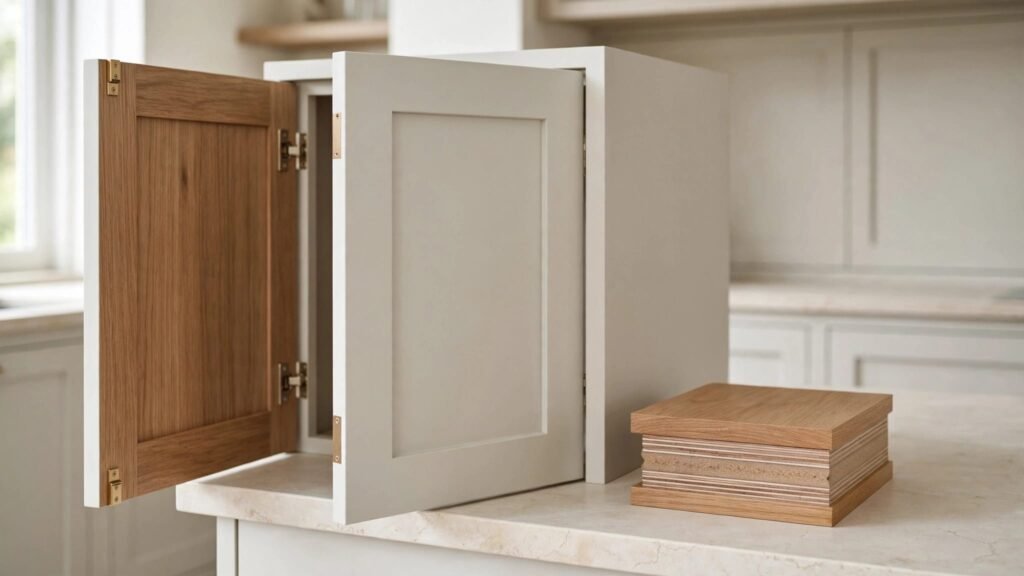
A cabinet door can feel solid in your hand and still be a poor fit for your kitchen. If you’re comparing samples, cabinet door thickness is worth checking, but the number alone won’t tell you how the door will hold up.
The material, door size, edge finish, and hinges all affect daily performance. Start by finding out exactly what the quoted thickness describes, then judge the complete door you’ll use.
Why cabinet door thickness is only part of the decision
Thickness can affect a door’s weight, profile, and hardware requirements. Yet two doors with the same overall measurement may be built differently. One might have a solid MDF face; another might have a wood frame surrounding a thinner center panel.
Ask where the measurement is taken
On a Shaker door, the outside frame and recessed center panel aren’t necessarily the same thickness. A decorative edge can make another door look substantial without changing its main body.
Ask whether the specification describes the finished door at its thickest point, the frame, or the center panel. Then confirm that the sample uses the same construction as the door on your quote. Without that detail, comparing measurements across styles can be misleading.
Keep door and cabinet-box specifications separate
Cabinet quotes may list thicknesses for doors, shelves, side panels, and backs. Each number describes a different component. A sturdy door can’t compensate for a box that flexes or sits out of square.
If you’re comparing complete kitchens, inspect the box alongside the door. These quality cabinet construction checks can help you look beyond the most visible surface.
Choose the construction before chasing a bigger number
The best thickness for a particular door depends on how its material and joints work together. Ask what makes up the full door, including its face, core, edges, and back.
Understand framed and one-piece doors
A traditional five-piece door has rails, stiles, and a center panel. Its frame joints need to remain sound, while the panel must fit the construction the manufacturer designed. Depending on the style, the panel may be recessed or raised.
A one-piece MDF door can provide a smooth surface for paint, without frame joints across its face. Wood doors offer natural grain, but their construction must account for wood movement. Neither format is automatically the longer-lasting choice. Compare the joint quality, finish coverage, and suitability for the door’s planned size.
Look beneath veneer and laminate
A veneer or laminate door includes a surface and a substrate beneath it. Ask what the substrate is, how the surface attaches, and how the edges are finished. A good-looking face won’t protect an exposed or lifting edge from repeated splashes.
Material names alone aren’t enough. MDF, plywood, and particleboard vary by product and application, and a cabinet box may use a different material from its door. The written specification should make that distinction clear.
Match the door to its size and style
A small upper-cabinet door and a tall pantry door place different demands on hinges and construction. That makes the dimensions on your layout more useful than a thickness figure viewed alone.
Review tall, wide, and detailed doors
Ask the cabinet maker whether the selected construction is approved for each planned door size. Large fronts may need different hinge support or a different construction than smaller doors in the same room. Don’t assume that ordering a thicker version of a preferred style solves those requirements.
Profiles matter, too. Raised panels, deep edge details, and narrow rails change where material sits and how a door feels. Check the full-size sample rather than judging its profile in a catalog photo.
Check clearances before settling on a profile
A thick edge or projecting detail can affect how a door opens beside a wall, appliance handle, or neighboring cabinet. Inset doors also depend on carefully planned gaps around the opening. Full-overlay doors need room to swing without striking adjacent fronts.
Framed and frameless boxes offer different mounting conditions. If you’re choosing between them, compare the differences between framed and frameless cabinetry before approving door sizes and hardware. The door should suit the complete cabinet design, not merely its appearance when closed.
Make sure the hinges suit the door
Door weight increases with size as well as construction. A heavy door on unsuitable hinges can be difficult to keep aligned, even when its face and finish are excellent.
Confirm the approved hinge setup
Ask which hinge model the manufacturer specifies for the chosen door dimensions and weight. Also ask how many hinges each door needs. A tall pantry door may need a different arrangement from a short wall-cabinet door.
Concealed hinges require holes drilled to match the hardware. A 35 mm hinge cup is common, but cup size alone doesn’t establish compatibility. Drilling depth, position, mounting plate, and door construction matter too. Let the cabinet supplier confirm those details rather than selecting hardware by sight.
Test the door’s movement
Open a working display door at a normal pace, then close it gently. It should move without rubbing, hanging unevenly, or striking nearby fronts. Soft-close hinges can reduce the impact of repeated slamming, but they won’t fix poor alignment.
If you’re replacing doors on existing boxes, record the current hinge locations and overlay. A new door with a different thickness or edge profile may need new hinges or plates, even when its width and height match.
Plan for moisture, heat, and Florida light
In a Fort Myers kitchen, cabinet doors encounter cooking steam, sink splashes, air-conditioning cycles, and strong sunlight. Those conditions put as much pressure on edges and finishes as they do on the door core.
Give vulnerable edges a closer look
Inspect the areas beside the sink and dishwasher, where water or steam may reach a door repeatedly. Edge banding should meet the face cleanly, without gaps, lifting, or exposed substrate. On painted doors, look for consistent finish coverage around corners and on the back.
Wood can shift with seasonal humidity changes. Well-joined frames and stable engineered constructions can help limit problems, but no indoor door is waterproof or warp-proof. For local material considerations, review choosing cabinets for humid kitchens.
Consider finish care by location
Ask for the manufacturer’s guidance near ranges, dishwashers, and sunny windows. Heat can affect some surface materials, while strong daylight can change how a finish looks over time. Check a sample in your kitchen’s natural light, not only under showroom lighting.
Daily care matters as well. Wipe splashes promptly, dry damp areas, and use the cleaner the manufacturer recommends. Repair leaks rather than relying on a thicker door to tolerate standing water.
Inspect a real sample from every side
A photograph can show color and style. It can’t tell you whether the back feels finished, the edge is tight, or the door moves well on its hinges.
Look at the front, edge, and back
Hold the sample at the angle you’ll see when opening the cabinet. Check the transition between the face and edge, then inspect the back for consistent finishing. Run a hand over the corners to find rough spots or uneven seams.
Compare samples in the same finish and similar size when possible. A tiny display piece may not reveal the weight or proportions of a full kitchen door. For a practical inspection routine, use this guide to evaluating cabinet door samples.
Ask what the sample actually represents
Showroom doors sometimes demonstrate a style or color rather than the exact construction on your estimate. Confirm the brand, product line, substrate, finish, and hardware before treating the sample as a match.
If a display door includes hinges, open it several times. Watch whether it sits square when closed and whether the gaps remain even. Those observations tell you more about the assembled door than its thickness alone.
Get the complete specification in writing
A quote that says “thick doors” leaves too much open to interpretation. Ask for the exact door style and its construction details, especially if you’re comparing cabinets from different lines.
For each option, request the same information:
- The finished door thickness and where the manufacturer measures it.
- The material and construction of the frame or main body, plus any center panel.
- The face, back, and edge finishes, including care instructions.
- The approved door dimensions and hinge arrangement for your layout.
- The box construction, warranty terms, and any charges tied to a different door or hinge choice.
Compare full project prices, not an isolated door upgrade. Changing a front may also affect hinges, finished end panels, trim, or installation work. If you’re keeping existing boxes, have the cabinet professional verify openings and hinge positions before ordering.
Brands such as KraftMaid, Fieldstone Cabinetry, and UltraCraft offer multiple cabinet choices, so a brand name isn’t a door specification. Ask which series and door style the estimate includes. That gives you a reliable basis for comparing durability, appearance, and cost.
Key Takeaways
- Treat cabinet door thickness as one specification, alongside construction, dimensions, edge finishing, and hardware.
- Compare the exact door on your quote with a physical sample, and confirm where its thickness is measured.
- For a busy kitchen, pay particular attention to hinge support and edges near water or steam.
Common questions about cabinet door thickness
Is a thicker cabinet door always more durable?
No. Thickness doesn’t reveal the quality of the substrate, joints, finish, or hinges. A well-built door suited to its opening can be a better long-term choice than a heavier door with weak edges or inadequate hardware.
Should every door in my kitchen have the same thickness?
Matching thickness can help create a consistent look, but different door styles may have different constructions. Focus on compatible profiles, finishes, and approved sizes. Check that neighboring doors open freely and look balanced when closed.
Can I choose a new thickness when replacing old doors?
You can consider a different door, but don’t order from the old width and height alone. The replacement must work with the existing box, overlay, hinge drilling, and nearby clearances. Have those measurements checked before production.
Choose the door as part of the whole cabinet
The door that lasts isn’t necessarily the thickest one in the showroom. It’s the one whose construction, finish, dimensions, and hinges fit the way you use your kitchen.
Ask for the exact specification, inspect the matching sample, and check how it will perform in its planned location. A measured decision will serve you better than choosing by feel alone.
