
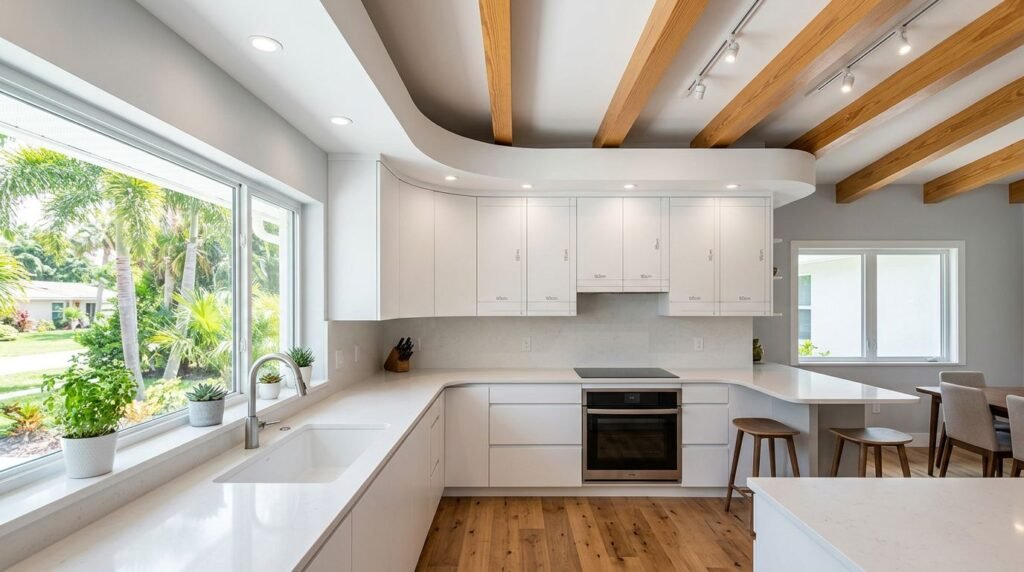
Fort Myers kitchen soffits can make a remodel feel tricky fast. They sit between the cabinets and the ceiling, and they can steal storage, create awkward gaps, or make a new kitchen look unfinished.
Good cabinet design starts with the soffit, not after the cabinets are ordered. If you plan around it early, you can get cleaner lines, better storage, and fewer surprises during install.
Why soffits shape the whole cabinet plan
A soffit changes more than the top of the wall. It changes the cabinet height, the cabinet layout, and the way the room reads when you walk in.
In many Fort Myers homes, soffits hide ductwork, wiring, plumbing, or framing changes. That means they are often part of the house, not a mistake that can be ignored. If you size cabinets without checking them, you can end up with a short upper section that looks out of place.
The visual effect matters too. A kitchen with random gaps above the uppers can feel chopped up. A kitchen with the right cabinet height and trim can look calm and finished.
Measure the soffit before you order anything
Before you pick cabinet sizes, measure the full wall carefully. Check the height from the counter to the bottom of the soffit, the depth of the soffit, and the length of the run. Also check the ceiling height, because a soffit that looks simple can still change how trim and crown fit later.
You also need to know if the soffit is level. Some are not. A wall that drops even a little can make standard upper cabinets look uneven once they go in.
A quick sketch helps. Mark the sink, range, refrigerator, windows, and any wall breaks. Then note where the soffit starts and stops. That drawing gives your cabinet designer a much clearer picture than a rough guess.
Never assume a soffit is empty. Treat it like a sealed box until someone verifies what’s inside.
If the soffit hides anything mechanical, the cabinet plan may need to stay flexible. That’s far easier than changing the design after delivery.
Cabinet layouts that fit different soffit situations
The best cabinet layout depends on what the soffit does and how much room you have above and below it. This quick comparison can help narrow the choice.
| Cabinet approach | Best when | Main tradeoff |
|---|---|---|
| Keep the soffit and stop the uppers below it | The soffit hides utilities or removal isn’t worth the cost | Less vertical storage |
| Partial-height uppers | You want a cleaner fit without full-height cabinets | May need trim or filler to finish the top edge |
| Stacked cabinets | You want more storage and have enough wall height | Higher cost and a stronger visual presence |
| Remove the soffit | The soffit is not structural and utilities can be rerouted | More labor, drywall repair, and finish work |
The right answer usually comes from the wall itself, not a trend. A low soffit may push you toward a simpler upper cabinet run, while a higher ceiling may open the door to stacked cabinets or taller uppers.
Keep the soffit and stop the uppers below it
This is often the cleanest choice when the soffit hides important systems. The upper cabinets stop below the soffit line, and a trim detail finishes the top edge.
That approach works well when you want a neat, balanced look without opening walls. It also keeps the project simpler if the soffit contains HVAC or electrical lines.
To make this look intentional, the cabinet tops should line up across the wall. If one section sits lower than another, the room can look uneven. Consistent heights matter more than squeezing in one extra inch of storage.
Choose partial-height uppers
Partial-height uppers are a good middle ground. They fill more of the wall than a short cabinet run, but they still respect the soffit height.
This option works well when the soffit sits low enough to make standard uppers feel small. It can also help in kitchens where you want a lighter look than full-height cabinets would create.
Glass doors, open shelving, or simple slab fronts can help these cabinets feel lighter. Even so, the top edge still needs a clean finish. A cabinet that nearly reaches the soffit but leaves a rough gap looks unfinished.
Stack cabinets for more storage
Stacked cabinets make sense when you need more storage and the wall height allows it. A standard upper cabinet can sit below a smaller top cabinet, which gives you extra space for less-used items.
This layout works especially well in kitchens with taller ceilings and a soffit that leaves enough room for two cabinet rows. It can also help a room feel more custom, because the wall looks fully planned instead of patched together.
Still, stacked cabinets add visual weight. If the room is small, too much height can make it feel crowded. Good cabinet design balances storage with proportion, so the wall looks full, not heavy.
Remove the soffit only after utility checks
Removing a soffit can open the room and give you more cabinet height. It can also make the kitchen feel larger and more modern.
That said, it only works when the hidden utilities can be moved safely. If the soffit contains ducts, vents, plumbing, or wiring, the job becomes more involved. You may need trades for each part of the reroute, plus drywall repair and paint after the cabinet install.
If the soffit is purely decorative, removal may be worth the effort. If it carries important systems, keeping it and designing around it may be the smarter choice.
Trim, fillers, and finishes that clean up the look
Small finish details matter more than people expect. A cabinet wall with the right fillers and trim pieces can look custom, even when the soffit stays in place.
Fillers help cabinets meet the wall cleanly. They also create room for small shifts in framing, which is common in older homes. Without them, a cabinet can end up jammed against the soffit or pushed too close to a wall.
Crown molding can help bridge the cabinet top and the soffit, but it has to fit the design. A heavy crown on a low soffit can make the wall feel taller in a bad way. A slim profile often works better when the ceiling line is tight.
Side panels matter too. If one end of the cabinet run finishes near an open edge, a finished panel can make the whole wall look built-in instead of added later.
Good trim work does more than hide gaps. It makes the soffit feel like part of the room plan.
Hidden HVAC, plumbing, and wiring need their own plan
Soffits often hide the parts of a kitchen nobody wants to think about until the demo starts. That can include ductwork, electrical runs, plumbing, or a mix of all three.
Because of that, the soffit should be checked before cabinet ordering begins. A cabinet wall can look perfect on paper and still fail if a line sits where a tall upper cabinet needs to go.
A soffit over a sink wall can affect plumbing. A soffit over a range wall can affect venting. A soffit on a long run can hide several smaller runs at once. Each case changes the cabinet layout.
When the hidden work has to move, the project usually gets more time-intensive. When it stays where it is, the cabinet plan needs to fit around it. Either way, the utilities drive part of the design.
Budget and timeline changes to expect
Soffits can change the budget in a few clear ways.
- Utility relocation adds labor because more than one trade may be involved.
- Custom fillers, panels, and trim pieces add material and shop time.
- Stacked cabinets or taller uppers usually cost more than standard wall cabinets.
- Soffit removal creates extra drywall, patching, and paint work after the cabinet install.
That doesn’t mean a soffit always makes the project expensive. Sometimes the simplest plan is also the smartest. If the soffit is staying, you can save money by designing around it cleanly instead of forcing a wall to do more than it can.
Timeline matters too. Cabinet delivery, trade work, and finish repairs need to line up in the right order. If the soffit is changing, the cabinet schedule should follow the structural and utility work, not the other way around.
Conclusion
Fort Myers kitchen soffits do not have to control the whole remodel. They just need to be part of the plan from the start.
When you measure carefully, confirm what the soffit hides, and choose the right cabinet height and trim, the wall looks better and the project stays more predictable. That’s the real goal of cabinet design in a kitchen with soffits, a layout that fits the room instead of fighting it.
The cleanest kitchen plans usually come from one simple rule, know the soffit first, then choose the cabinets.