 Skip to content
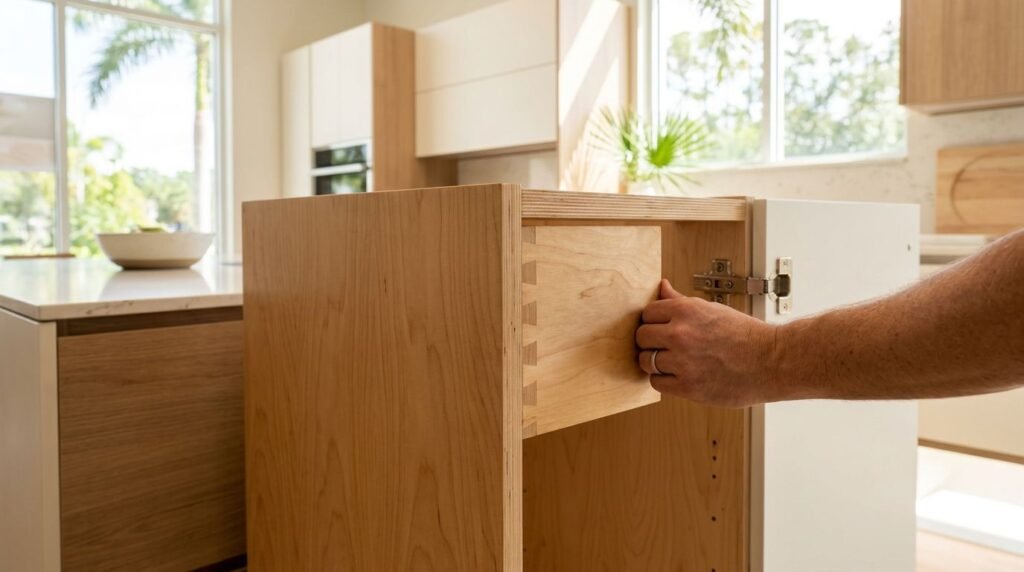
A glossy cabinet sample can hide weak work. The finish may look perfect, while the box, joints, and hardware tell a different story.
That’s why quality cabinet construction matters more than the display lighting. If you know what to touch, open, and test, you can spot the difference fast, even in a busy Fort Myers showroom.
Start with the cabinet box, not the door
The door gets the attention, but the box does the real work. It holds the load, keeps the cabinet square, and takes daily wear.
Open a sample cabinet and press on the sides, top, and back. A solid box should feel firm, not hollow or floppy. Look at the corners too. Clean, tight joins usually point to better build standards.
Material choice matters here. Plywood is often a stronger pick than particleboard because it handles screws better and resists moisture damage more effectively. Particleboard can work in some cabinet builds, but it needs strong edge protection and careful sealing. In a humid area like Fort Myers, that difference matters.
Pay attention to the back panel as well. Thin backs or loose backing can signal a shortcut. A sturdy cabinet box usually has a back that feels secure and adds support, not just a sheet tacked on for looks.
Good cabinet design also shows up in the way the box is engineered. A well-planned cabinet design uses the right material where stress is highest, then keeps the structure square and stable. If the sample feels stiff and well-fitted, that’s a good sign.
If you want a quick reality check, ask to see finished work, not only showroom samples. A custom kitchen cabinet portfolio helps you see how the construction holds up in real homes.
Drawer boxes tell the truth
Drawer fronts can look beautiful while the drawer box underneath cuts corners. That’s why drawers are one of the best places to inspect.
Pull a drawer all the way out. Check the side walls, the bottom panel, and the way the corners meet. Strong drawers often use dovetail joints, which lock the sides together well. Staples alone usually point to a lower-end build.
The drawer bottom should sit securely in a groove. If it looks thin or loose, expect trouble later. Heavy use, loaded silverware, and daily slams can expose a weak drawer fast.
Here’s a quick comparison that helps when you’re standing in the showroom:
| Feature | Better construction looks like | Lower-quality shortcut |
|---|---|---|
| Drawer box | Dovetail joints, sturdy sides, neat edges | Staples, thin panels, rough cuts |
| Slides | Full-extension, smooth motion, little wobble | Short travel, sticking, side play |
| Bottom panel | Set into a groove, secure and flat | Loose, thin, or stapled-on bottom |
| Finish inside drawer | Clean and even | Bare patches, rough spots, overspray |
The takeaway is simple. If the drawer feels flimsy, the cabinet probably hides other weak points too.
Check the slides and hinges with your hands
Hardware gives away a lot. Open and close the sample doors several times. Then do the same with the drawers.
Soft-close hinges should move smoothly and catch near the end without a slam. They shouldn’t grind, click loudly, or feel jerky. Full-extension slides should let the drawer come all the way out so you can reach the back. If you can’t see or use the back half easily, that space turns into wasted storage.
Look at alignment too. Doors should have even gaps. Drawer fronts should sit level. When the gaps look uneven in the showroom, they may get worse after a few months of use.
If a sample feels sloppy in the showroom, assume the hidden parts follow the same mindset.
Also, check for easy adjustments. Good hinges usually allow fine tuning so the installer can line things up after mounting. That matters because even a strong cabinet can look cheap if the hardware can’t be adjusted well.
Shelf sag and finish consistency reveal shortcuts
Shelves take more abuse than many buyers expect. Plates, canned goods, bath items, and small appliances all add weight over time.
Press down lightly on the middle of a shelf. It should feel firm. If it bows under a small amount of pressure, that shelf may sag once it’s loaded at home. Thick shelves or reinforced spans usually hold up better.
The finish also deserves a careful look. Run your eyes across the doors, drawer fronts, end panels, and inside edges. Color should stay consistent. Paint should look smooth, not streaky. Stain should look even, with no blotches or thin areas.
Look inside the cabinet, too. Rough overspray, peeling edge banding, or uneven coating near corners often points to rushed production. In a kitchen, those weak spots get noticed fast.
In Fort Myers homes, humidity can make sloppy finish work fail sooner. Sealed edges, neat paint lines, and well-covered cut points matter because moisture finds the weak spots first.
Ask questions that expose weak construction
A showroom conversation can tell you a lot, if you ask direct questions. A confident answer usually sounds clear and specific. A vague answer often hides weak details.
Ask these questions while you’re there:
- What material is used for the cabinet box and drawer box?
- Are the drawer joints dovetailed or stapled?
- Are the slides full-extension and soft-close?
- What is the warranty on hardware, finish, and cabinet boxes?
- How are shelves supported in wider cabinets?
- What changes when the cabinet is used in a bath, laundry room, or near a sink?
Those questions matter because quality cabinet construction should be easy to explain. If the salesperson talks only about style, color, or door profile, keep digging. Finish can hide a lot, but it can’t fix a weak structure.
If you’re comparing repair options, a refacing vs full replacement guide can help you decide whether your current boxes are worth keeping. That question becomes much easier once you know how to judge the box itself.
Fort Myers homes need a closer look
Southwest Florida brings heat, humidity, and plenty of year-round use. That puts extra pressure on cabinet materials and finishes.
A cabinet that looks fine in a dry showroom may react differently in a real kitchen or bath. Edges can swell, finish can crack, and hardware can loosen if the build is weak. That’s why local buyers should pay attention to sealed edges, moisture-prone areas, and the quality of the core materials.
Outdoor spaces deserve even more care. If you’re looking at outdoor entertainment cabinetry, ask how the materials handle moisture and temperature swings. The same goes for bathroom vanities and laundry areas. Those rooms expose shortcuts fast.
When possible, compare the showroom sample with completed projects. Seeing a cabinet portfolio gives you a better sense of how the cabinets look after installation, not just under showroom lights.
Conclusion
The best showroom cabinets don’t need a sales pitch to prove their value. They feel solid, open smoothly, line up cleanly, and keep their shape when you test them.
If you remember one thing, make it this: the real signs of quality cabinet construction are hidden in the parts you touch first. Check the box, test the drawers, inspect the finish, and ask direct warranty questions before you decide.
That simple habit can save you from expensive regrets later, especially in Fort Myers, where cabinets need to stand up to daily use and local humidity.
