
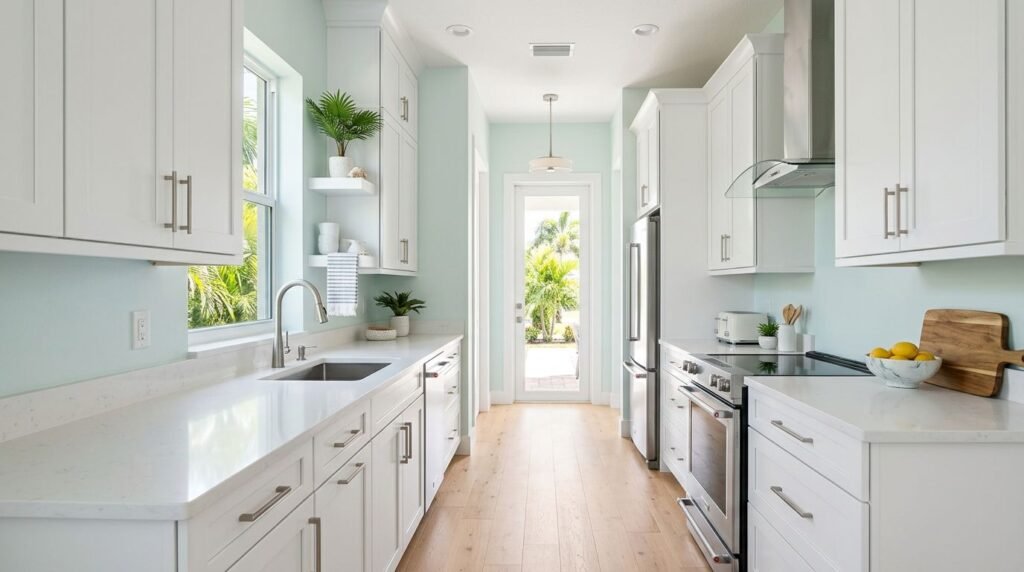
A galley kitchen can feel tight fast, especially in a Fort Myers home where humidity, salt air, and daily traffic all test the cabinets. The good news is that a narrow kitchen can still feel open, bright, and easy to live in.
The right galley kitchen cabinets do more than hold dishes. They help the room stay cleaner, resist moisture, and give you storage without crowding the aisle.
Start with the layout, because in a galley kitchen, every inch matters.
Build around the narrow layout, not against it
Galley kitchens work best when the cabinet lines stay clean and predictable. Two long runs of cabinetry already create strong visual lines, so extra ornament can make the room feel smaller.
Keep the aisle clear and think about how doors and drawers open. A deep drawer that bumps into the dishwasher or a corner door that blocks traffic gets old fast.
Cabinet height matters too. Tall uppers can give you more storage, but they should not hang so low that the room feels boxed in. In many Fort Myers homes, a lighter upper cabinet line helps the kitchen feel taller.
In a galley kitchen, every cabinet choice changes the feel of the room because the space is short, narrow, and highly visible.
A good cabinet design also respects how you cook. If you prep often, place knives, cutting boards, and bowls close to the main work zone. If you entertain, make room for serving pieces near the dining side. That way, the kitchen works with your habits instead of forcing new ones.
Choose materials that handle Fort Myers humidity
Heat and moisture can wear on cabinets faster in Southwest Florida. For that reason, the box construction and finish matter just as much as the door style.
Look for cabinet boxes with solid joinery, well-sealed edges, and moisture-conscious materials. High-quality plywood boxes are often a strong choice because they hold up well in busy kitchens. Door panels should also have durable edge sealing, since moisture often finds weak spots first.
Finish choice matters, too. A smooth factory finish, properly sealed paint, or a well-applied stain can all work, but the surface needs to be easy to wipe down. Satin and semi-gloss finishes are popular because they clean more easily than flat finishes.
For homeowners comparing cabinet upgrades, the Fort Myers cabinet refacing vs replacement guide can help clarify whether your existing boxes are worth keeping.
A few material habits also go a long way:
- Wipe spills fast, especially near sinks and dishwashers.
- Keep sink bases well sealed and check for leaks often.
- Use cabinet liners where wet items are stored.
- Avoid letting steam sit inside closed cabinets after cooking.
These small steps help the cabinets last longer and keep the kitchen looking fresh. In a humid climate, protection is part of the style.
Bright colors and simple door styles keep the space open
Narrow kitchens usually look better with lighter cabinet colors. White, soft ivory, pale gray, sand, and light blue-green all fit Fort Myers homes well. They bounce light around and make the room feel less crowded.
Two-tone cabinets can work nicely in a galley layout. For example, lighter uppers with slightly deeper lowers can ground the room without making it feel heavy. A soft coastal palette also pairs well with bright countertops and simple backsplashes.
Door style matters just as much as color. Flat-panel doors feel clean and calm. Slim shaker doors add a little detail without crowding the eye. Both are good choices when you want the kitchen to look tidy and open.
Glass-front uppers can also help, if you use them sparingly. They break up a long wall of solid doors and give the room a lighter look. Still, they work best when you keep the contents neat.
If you’re torn between a painted finish and a wood look, the Fort Myers guide to cabinet paint vs stain is a helpful place to sort through the tradeoffs.
The key is balance. Bright colors create space, while too many mixed textures can close it back down.
Storage features that make galley cabinets work harder
A narrow kitchen needs storage that saves steps. When the layout is tight, deep drawers and smart inserts often matter more than extra square footage.
Think about what you reach for most often. Then give those items the best spots. Good storage keeps the counters clear and makes the aisle feel less cluttered.
Useful features for galley kitchen cabinets include:
- Deep drawers for pots, pans, mixing bowls, and small appliances.
- Pull-out trays for items tucked in the back of base cabinets.
- Vertical dividers for baking sheets, trays, and cutting boards.
- Trash and recycling pull-outs that keep bins off the floor.
- Drawer organizers for utensils, lids, and cooking tools.
- Under-sink organizers that work around plumbing and cleaners.
- Tall pantry cabinets at one end of the run, if the wall space allows.
These features matter because they turn awkward cabinet space into useful space. A wide drawer is often more practical than two shallow ones. Likewise, a pull-out tray can save time every day.
If your kitchen needs a more personalized setup, custom cabinet design can add narrow spice pull-outs, tray dividers, or a charging drawer. Small details like that make the room easier to use without making it look busy.
Hardware and small details that make daily use easier
Hardware may seem minor, but it changes how cabinets feel every single day. In a galley kitchen, that daily touch adds up fast.
Pulls are often the better choice for drawers because they’re easier to grab when your hands are full. Knobs can still work well on upper doors or lighter-use cabinets. Many Fort Myers homeowners mix the two for a practical, clean look.
The Fort Myers cabinet knobs vs pulls comparison is useful if you want a side-by-side look at the options. It can help you match the hardware to your comfort, budget, and cabinet style.
For finish, brushed nickel, stainless steel, and other corrosion-resistant options tend to hold up well in humid homes. Matte black can look sharp, too, especially in a lighter kitchen. The best choice depends on the look you want and how much contrast you like.
Soft-close hinges and drawer slides also make a difference. They reduce slamming, which helps preserve the cabinets over time. In a small kitchen, that softer motion also makes the space feel calmer.
Small details can help visually, too. Slim pulls, concealed hinges, and simple edge profiles keep the cabinet run looking light. The less visual clutter on the doors, the more open the kitchen feels.
When refacing is enough, and when replacement makes sense
Sometimes the best cabinet idea is not a full rebuild. If the cabinet boxes are solid and the layout already works, refacing can give you a fresh look without changing the bones of the kitchen.
That can be a strong option for a galley kitchen with good storage but dated style. New doors, drawer fronts, and finishes can change the feel of the whole room. It’s often the cleaner path when the main problem is appearance, not function.
Replacement makes more sense when the cabinets are damaged, warped, or poorly placed. If the aisle feels cramped because the layout is wrong, new cabinet placement can solve problems that new doors can’t fix. The same goes for water damage, soft spots, or shelves that no longer hold weight well.
Here’s the simple rule: if the cabinet boxes are healthy, refacing may be enough. If the structure or layout is weak, replacement gives you more freedom.
A thoughtful plan saves money and frustration later. It also keeps the kitchen from looking patched together.
A better galley kitchen starts with the cabinets
The best cabinet ideas for a Fort Myers galley kitchen all point in the same direction. They use moisture-smart materials, bright finishes, and storage that fits a narrow footprint.
When the cabinets are chosen well, the room feels easier to move through and easier to keep clean. That matters more in a compact kitchen than any decorative trend.
A narrow kitchen doesn’t need more visual weight. It needs smarter cabinet design, a lighter finish, and storage that works as hard as you do.