
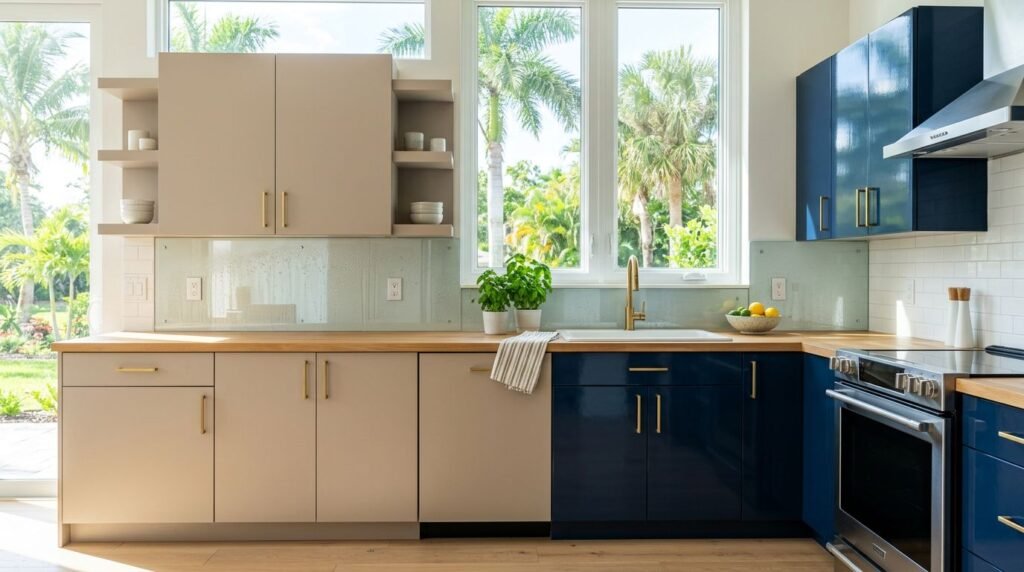
Southwest Florida kitchens put cabinet doors through more stress than many homeowners expect. Humidity, salt in the air, and constant cooling cycles can wear on a finish faster than it looks in a showroom.
If you are weighing thermofoil vs painted cabinets, the right answer depends on heat, moisture, and daily use. A door that looks clean and modern on day one can age very differently in a Fort Myers or Naples kitchen.
This guide breaks down the practical differences so you can pick a finish that fits your home, your budget, and your routine.
Why Southwest Florida homes test cabinet finishes
Humidity is the biggest factor. Cabinet doors expand and contract as indoor air changes, and that movement often shows up first at edges, seams, and corners.
Coastal air brings its own mess. Salt particles settle on surfaces, dull the sheen, and add another layer to weekly cleaning.
Then there are indoor cooling cycles. A kitchen may feel damp in the morning, then cooler and drier once the AC runs hard. That shift can stress weak adhesives and less flexible finishes.
Heat matters too. Doors near ovens, dishwashers, coffee makers, and sunny windows get hit from several directions at once. In Southwest Florida, that adds up fast.
Cabinet doors in this climate need more than a pretty finish. They need a finish that can handle heat, moisture, and daily cleaning.
What thermofoil offers in a humid kitchen
Thermofoil cabinet doors usually start with an MDF core wrapped in a vinyl film. The result is a smooth, even surface with no grain and no brush marks. For a clean, modern kitchen, that look can work well.
Cost is part of the appeal. Thermofoil often comes in lower than painted doors, which matters when you want a fresh look without a full-scale remodel. It also wipes down easily, so fingerprints, sauce splashes, and cooking residue do not linger long.
The weak spot is heat. Too much direct heat can loosen the bond at the edge or corner, and once that happens, repairs are limited. A peeling thermofoil door rarely blends back in perfectly.
That is why placement matters. Thermofoil can work in a kitchen with good ventilation and moderate sun exposure. It is less comfortable near a range, a toaster oven, or a bright slider that bakes the same cabinet every afternoon.
The finish itself also has a look that some homeowners love and others do not. It reads smooth and uniform, which suits slab doors and simple profiles best. If you want a soft, painted feel with visible depth, thermofoil can seem a little flat.
For a busy kitchen, the upside is clear. For a hot, sunlit one, the tradeoff becomes harder to ignore.
Why painted cabinet doors stay popular
Painted cabinet doors give you more room to match the rest of the house. Soft white, sand, pale green, navy, and warm gray all fit naturally in Southwest Florida homes. That range makes painted doors a strong choice when cabinet design is part of the room’s style plan.
Paint also adds visual depth. Even on a simple door, the finish can feel richer than vinyl wrap. Many homeowners like that because it looks more tailored and less factory-made.
Material matters here as well. Painted doors may use wood or MDF, and each behaves differently. MDF stays flatter through moisture swings, while solid wood moves a bit more. Both can work, but the finish quality and sealing are just as important as the base material.
Paint does have wear points. Corners chip. Handles scuff. Sink bases take a beating. In a kitchen that gets heavy use, those marks usually show up first around drawers, trash pullouts, and the most touched doors.
A good painted finish is easier to repair than thermofoil, though. Small chips can often be touched up, even if the repair is never invisible. That matters in homes where cabinets need to look good for years, not just months.
Painted doors also give you more flexibility with sheen. A satin or soft-matte finish usually hides smudges better than high gloss, while still feeling polished.
Thermofoil vs painted cabinets at a glance
Here’s a simple side-by-side look at the details that matter most in a Southwest Florida kitchen.
| Feature | Thermofoil doors | Painted cabinet doors |
|---|---|---|
| Heat exposure | Can peel or lift near ovens, toasters, and sunny spots | Handles heat better when built and finished well |
| Moisture response | Surface wipes clean, but damaged edges are vulnerable | Good with proper sealing, though chips can happen |
| Repair options | Hard to patch without replacing the door | Touch-ups are possible, but not always invisible |
| Style range | Smooth, uniform, and modern | Wide color choice, from classic to bold |
| Day-to-day upkeep | Easy to clean, low maintenance | Easy to clean, but chips need attention |
| Best fit | Budget-conscious updates in lower-heat areas | Homeowners who want color flexibility and easier repairs |
The takeaway is simple. Thermofoil can work well in the right spot, but painted doors usually give you more room to fix wear over time.
When a door choice is not enough
Sometimes the finish is not the real issue. If cabinet boxes are swollen, hinges keep failing, or the layout wastes space, new doors only cover the problem.
That is where a bigger decision comes in. Comparing cabinet refacing and full replacement helps separate cosmetic updates from structural fixes. Refacing makes sense when the boxes are solid and the layout still works. Replacement fits better when water damage, warped parts, or poor storage get in the way.
Southwest Florida homes also deal with sink leaks, dishwasher steam, and floor-level moisture. If the lower cabinets have taken on damage, a fresh finish will not solve soft material underneath. In that case, the cabinet system needs a closer look before you choose a door style.
A strong cabinet design starts with the room’s worst conditions, not its best photo angle. If the cabinet structure is sound, either finish can work. If the structure is weak, the door choice matters less than the fix underneath.
How to choose for your remodel
Start with heat exposure. If your kitchen gets long afternoon sun or sits close to the cooktop, painted doors are often the more forgiving option. They handle small blemishes better, and they give you more finish choices.
Then think about budget and upkeep. If you want a smooth, clean look at a lower price point, thermofoil can still make sense. It works best where heat and steam are not constant problems.
Next, look at how the room functions. Busy family kitchens need finishes that can take repeated cleaning and daily contact. Guest kitchens or lower-use spaces may give you more freedom to choose for appearance alone.
A professional cabinet design consultation can help you sort through those details before you commit. That kind of planning matters when you want the finish, lighting, and hardware to work together instead of fighting each other.
No matter which door material you choose, simple care helps. Wipe cabinets with a soft cloth, use mild soap when needed, and dry the area around sinks and dishwashers after heavy use.
Conclusion
In Southwest Florida, cabinet doors have to do more than look good. They need to handle humidity, heat, salt air, and the daily rhythm of a busy kitchen.
Thermofoil works best when you want a smooth, affordable finish in a lower-heat space. Painted doors give you more color freedom and more repair options, which often makes them the stronger long-term choice.
When you compare thermofoil vs painted cabinets, look at your sink, range, windows, and AC use before you look at the sample board. The finish that fits those conditions will usually age better, and that is what you will notice every day.