 Skip to content
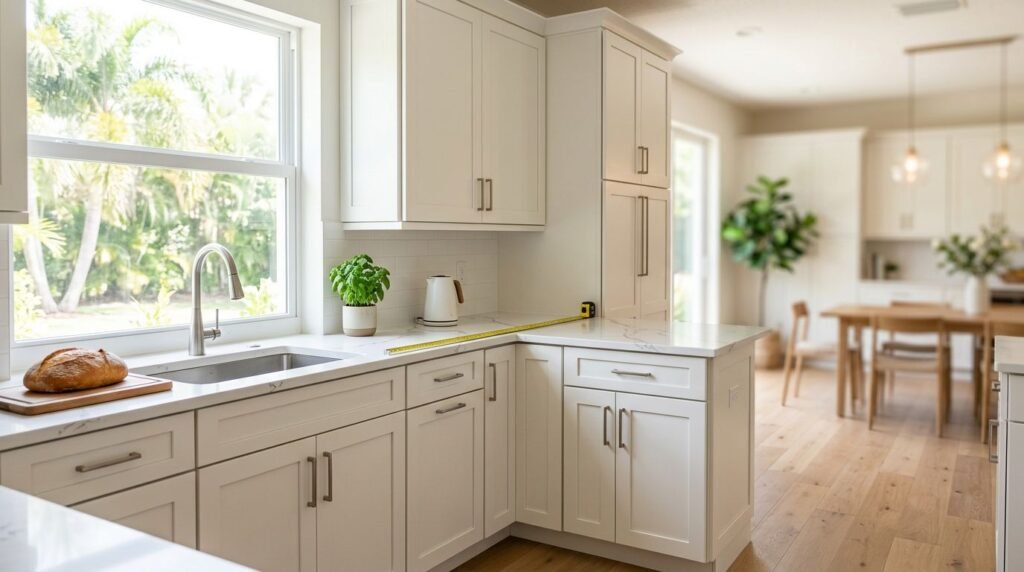
A kitchen remodel feels simple until you’re staring at a tape measure and a blank wall. Cabinet boxes look like they should “just fit,” yet a few inches can decide whether drawers open, stools tuck in, or your fridge door bangs a handle.
This guide breaks down kitchen cabinet sizes in plain language, then connects them to real Fort Myers home layouts. You’ll see common size ranges (in inches, with a few metric notes), plus clearance rules that keep your plan comfortable. Always confirm your kitchen’s measurements on-site before ordering, because walls and floors rarely behave.
Standard kitchen cabinet sizes, decoded (base, wall, and tall)
Most kitchens use three cabinet types: base cabinets on the floor, wall cabinets above, and tall cabinets for pantry or oven towers. Manufacturers offer “standard” sizes because they align with typical appliances and countertop heights.
Base cabinets usually land at 34.5 in tall (87.6 cm) for the cabinet box. Add a 1.5 in countertop and you get a 36 in working height, which is the norm. Depth is commonly 24 in (61 cm), matching most counters and ranges. Widths vary to build your run like puzzle pieces.
Here’s a compact reference for base cabinet sizing:
| Base cabinet type | Typical height | Typical depth | Common widths |
|---|---|---|---|
| Standard base (drawer/door) | 34.5 in | 24 in | 9 to 48 in |
| Sink base | 34.5 in | 24 in | 30 to 36 in (sometimes 42 in) |
| Corner base (lazy susan/diagonal) | 34.5 in | 24 in | 33 to 36 in (each wall) |
| Base for cooktop/range | 34.5 in | 24 in | 30 to 36 in |
Wall cabinets handle everyday storage, but height choices change the whole look. Common heights are 30, 36, or 42 in (76 to 107 cm). Depth is usually 12 in (30.5 cm), so you don’t bonk your head, although 15 in versions show up for extra capacity.
| Wall cabinet type | Typical height | Typical depth | Common widths |
|---|---|---|---|
| Standard wall cabinet | 30/36/42 in | 12 in | 9 to 36 in |
| Over-fridge cabinet | 12 to 24 in | 12 to 24 in | 30 to 36 in |
Tall cabinets bring the “pantry wall” feel many Fort Myers homeowners want. Heights often match ceiling plans: 84, 90, or 96 in (213 to 244 cm). Depth is frequently 24 in to line up with base cabinets, especially for built-in oven or pantry storage.
| Tall cabinet type | Typical height | Typical depth | Common widths |
|---|---|---|---|
| Pantry cabinet | 84/90/96 in | 24 in | 18 to 36 in |
| Oven or microwave tower | 84/90/96 in | 24 in | 24 to 33 in |
Sizes sound rigid, but they’re meant to mix and match. Good cabinet design uses standards where they work, then adds fillers, panels, or custom pieces where the room demands it.
What fits Fort Myers homes, three practical layout scenarios
Fort Myers kitchens come in many shapes, from condo galleys near the beach to open-plan ranch homes with big gathering spaces. The right cabinet sizes depend less on trends and more on traffic, door swings, and how you cook.
Small condo galley kitchen (tight lanes, big storage needs)
A galley is like a hallway with appliances. Because space is limited, keep base cabinets at the standard 24 in depth, then protect your walking lane. Aim for about 36 in of clear aisle (91 cm) as a workable minimum, and more feels better if two people cook.
In this setup, taller wall cabinets often earn their keep. If ceilings allow, 36 to 42 in wall cabinets reduce the need for a bulky pantry. Also, wide drawers can beat extra doors in a narrow room because you see everything at once.
Open-plan ranch kitchen (long runs and social zones)
Open plans usually have room for wider base cabinets, which means fewer seams and more usable storage. Think 30 to 36 in drawer bases for pots and pans, plus a 36 in sink base if your sink is large or you want a pull-out trash setup.
If an island is part of the plan, cabinet sizing and clearances matter more than the island’s “look.” A deep island can eat the walkways fast. You can get ideas by browsing a local cabinet portfolio and paying attention to aisle space, not just finishes.
L-shaped kitchen with an island (corners and conflicts)
L-shapes win on efficiency, but corners can waste space if the cabinet choice is wrong. A 33 to 36 in corner base (or a blind corner solution) often works well. The goal is to keep the corner from blocking nearby drawers and dishwasher doors.
Islands in L-shaped kitchens should also respect appliance door swings. For example, a dishwasher door plus a person standing there can block the whole room if the aisle is too tight. Plan cabinet widths so the dishwasher sits where you naturally have space to pause.
Clearance rules of thumb that keep the kitchen comfortable
Cabinets don’t live alone. They share space with bodies, doors, and stools. These rules of thumb help your layout feel right the first time.
- Walkways: Try for about 42 in (107 cm) in a one-cook kitchen, and about 48 in (122 cm) where two people pass often. Smaller can work, but it feels cramped fast.
- Counter to wall cabinets: A common target is 18 in (46 cm) from countertop to the bottom of wall cabinets. That protects your prep space and small appliances.
- Island seating: A typical knee-space overhang is 12 in (30.5 cm). For taller seating or more comfort, many people prefer more. Allow about 24 in of width per seat so elbows don’t collide.
- Appliance door swings: Check the fridge door, oven door, and dishwasher door at full open. Then add a person’s standing space in front.
A quick gut check: if two doors can open into the same spot (dishwasher and oven, or fridge and pantry), you’ll feel it every day.
Also, plan for fillers and panels. A small filler next to a wall can prevent a handle from smashing drywall. It also helps drawers clear trim and keeps doors from rubbing.
Common cabinet sizing mistakes to avoid before ordering
Most cabinet problems come from guessing. The boxes are “standard,” but the room isn’t. Watch for these issues before anything gets ordered.
- Measuring wall-to-wall only: Corners are often out of square. Measure in several places, then plan for small fillers.
- Forgetting finished depth: A 24 in base cabinet becomes deeper once you add a door, countertop edge, and hardware. That can affect tight aisles.
- Assuming all appliances are standard: Counter-depth fridges, oversized ranges, and farmhouse sinks can change cabinet widths and clearances.
- Skipping landing space: Make sure you have a safe spot near the range and sink. A few inches of extra base cabinet can make that happen.
- Not planning for door and drawer conflicts: A corner drawer base can fight a dishwasher door, depending on placement.
- Ignoring ceiling details: Soffits, vents, and uneven ceilings affect whether 42 in wall cabinets make sense.
If you want a second set of eyes, a local team that does layouts daily can spot issues early. Learn more about the process and people behind it on TEC Cabinetry Plus, then bring your rough measurements and appliance list to the conversation.
Conclusion
Standard kitchen cabinet sizes give you a reliable starting point, but comfort comes from smart spacing and real measurements. Match cabinet heights and depths to your layout, then protect walkways, door swings, and seating space. Most importantly, verify every dimension on-site before you order, because drywall and corners like to surprise you. If your plan feels tight on paper, it’ll feel tighter in real life, so adjust early and enjoy the result.
