 Skip to content
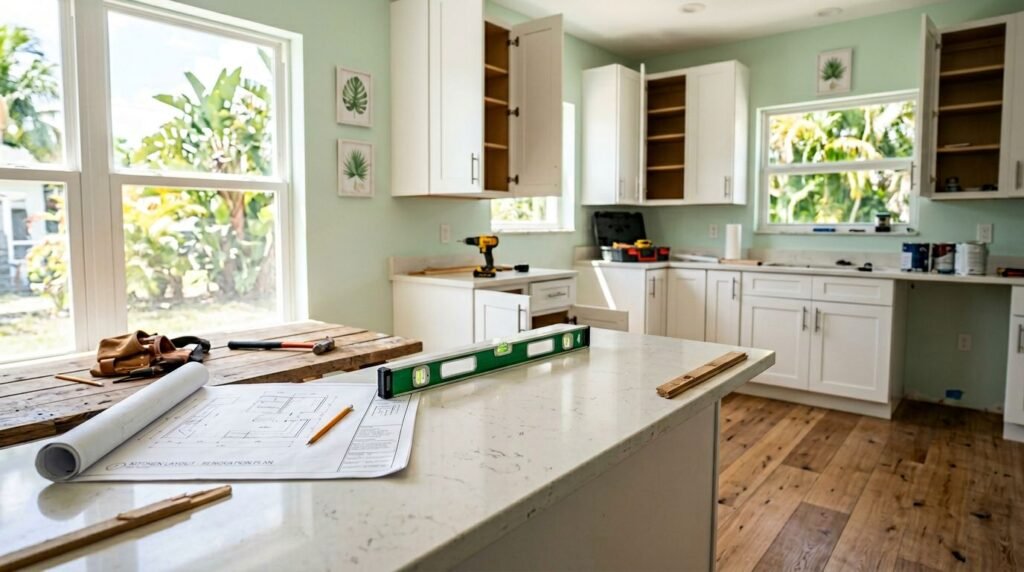
Bad kitchen cabinet measurements can turn a simple cabinet swap into a week of delays. Doors hit trim, fillers get bigger, and the “perfect” fridge sticks out like a sore thumb. If you’re planning a Fort Myers kitchen remodel, a careful measure is the cheapest insurance you can buy.
Think of measuring like setting a GPS route before a road trip. You can still change stops later, but you need the map first. Below is a homeowner-friendly guide to capture the details a cabinet designer and installer actually use.
If you want to see how accurate planning pays off, take a look at this Fort Myers remodel project gallery for real layout ideas and cabinet configurations.
What to do before you measure (so the numbers are usable)
Accurate cabinet planning starts with a clean slate, even if you’re not demoing yet. In Southwest Florida homes, small issues like bowed drywall, thick tile, or an out-of-square corner show up fast once new boxes go in.
Gather the right tools
You don’t need fancy gear, but you do need consistency.
- Tape measure (25 ft), pencil, and notepad (or a notes app)
- Painter’s tape to label walls and openings
- Step stool for upper-cabinet areas
- A level or a straight board (to spot dips and bumps)
Do two quick checks first
Start with these because they change everything later.
Check for out-of-square corners: Measure 24 inches out from the corner on both walls, then measure between marks. If it’s not about 33-7/8 inches, the corner isn’t square.
Check floor and wall swings: Run a level or straight board along the floor at the cabinet line. Even a 1/4-inch dip matters across a long run.
If something looks “close enough,” measure it anyway. Cabinets don’t forgive guesses.
Quick prep checklist (2 minutes)
- Remove small items from counters and windowsills
- Note anything staying put (tile, soffits, bulkheads, windows)
- Decide your “reference wall” (usually the sink wall)
For local help planning around Florida construction quirks, it can help to start with a team that does this daily. Here’s more about the Southwest Florida cabinetry team behind TEC Cabinetry Plus.
Step-by-step kitchen cabinet measurements (in inches)
Use inches as your main unit, then add mm in parentheses if you like. Measure each wall at least twice, and write down both numbers before you pick the final one.
1) Sketch the room
Draw a simple top-down view. Label walls A, B, C, D as you go clockwise. Add corners, even if the kitchen is open to another room.
2) Measure each wall length
Measure along the wall where cabinets will sit, baseboard to baseboard. Write the overall length for each wall segment.
3) Record ceiling height and soffits
Measure floor to ceiling in at least two spots per wall. Fort Myers homes often vary slightly. If you have soffits, measure:
- Floor to bottom of soffit
- Soffit depth (how far it sticks out)
4) Measure doors and trim
For each door near the kitchen, record:
- Door width (include casing)
- Distance from corner to casing edge
- Door swing direction (draw an arc)
5) Measure windows (all four directions)
Windows affect uppers, sink placement, and backsplash space. Record:
- Width (casing to casing)
- Sill height from finished floor
- Height to top of casing
- Any crank handles or deep trim that bumps into cabinets
6) Capture existing cabinet and counter runs (if staying similar)
If you like your current layout, measure:
- Countertop run length
- Distance between runs (walkway)
- Overhangs at peninsulas or bars
7) Measure plumbing and electrical “centers”
You don’t need to open walls. Use centerlines.
- Sink drain center from the corner
- Water supply centers
- Range outlet location
- Hood vent center (if present)
8) Measure appliance openings (and don’t assume “standard”)
Write the current opening width, height, and depth, plus clearances to doors and adjacent walls.
9) Measure corner conditions carefully
Corners are where cabinet design succeeds or fails. Note:
- Any return wall shortness
- Window or door casing near the corner
- How far a peninsula extends past the corner
Standard cabinet sizes and clearances that shape your layout
Even with perfect measuring, the layout still needs to “breathe.” That means planning for doors, drawers, and people moving around.
Here’s a quick reference table you can use while reviewing your sketch:
| Item | Typical size or clearance (inches) | Notes for planning |
|---|---|---|
| Base cabinet depth | 24 | Without countertop overhang |
| Base cabinet height | 34-1/2 | Add countertop to reach about 35 to 36 |
| Wall cabinet depth | 12 | Deeper options exist, but check headroom |
| Counter to wall-cabinet bottom | 18 | Common spacing above countertops |
| Walkway (one cook) | 36 | More space feels better in busy kitchens |
| Walkway (two cooks) | 42 to 48 | Helps with traffic and open appliances |
Takeaway: your kitchen cabinet measurements set the boundaries, but clearances decide whether the kitchen feels easy or tight.
Appliance gotchas to watch
A few common surprises show up in Fort Myers remodels:
Refrigerators: Many newer fridges need airflow space and door swing room. If the fridge sits near a wall, check handle clearance so doors can open past 90 degrees.
Dishwashers: They need a flat, correct-width opening. Also, the door drops into the walkway, so tight aisles feel smaller.
Ranges and hoods: Confirm the hood width and mounting height before you pick uppers. If you plan a slide-in range, measure the back clearance and countertop cutout needs.
Don’t plan cabinets around an appliance “type.” Plan around the exact model’s spec sheet.
When you’re comparing styles, finishes, and layouts, it helps to look at proven combinations. This view our kitchen cabinet portfolio link can spark ideas for corner solutions, islands, and pantry layouts.
How to prepare your measurements for cabinet quotes and ordering
Once your numbers are on paper, package them so a designer can price the job without chasing missing details. This step also reduces change orders later.
What to send for a cabinet quote (simple checklist)
- Your labeled sketch with wall lengths, windows, doors, and ceiling height
- A photo set, described clearly (example: “Wall A from doorway,” “Sink wall facing window,” “Corner by pantry”)
- Appliance spec sheets for fridge, range, hood, dishwasher, microwave, and any wall ovens
- Your desired layout (keep, adjust, or full re-work), plus notes on what bothers you now
- A short wish list (trash pull-out, wider drawers, pantry type, spice storage)
Small details that matter in cabinet ordering
Add these notes if you can. They help finalize cabinet design choices:
- Filler needs near walls or tall items
- Crown molding plans (to ceiling or not)
- Toe-kick height needs (common, but confirm if floors are changing)
- Any flooring changes, because finished floor height affects dishwasher fit
If you’d like a second set of eyes before ordering, you can book a cabinet design appointment and share your sketch and photos. It’s often faster than correcting problems after cabinets arrive.
Conclusion
Good kitchen cabinet measurements aren’t just numbers, they’re your remodel plan in disguise. Measure the room, capture openings and centers, then confirm clearances with the appliances you’ll actually install. After that, your cabinet design options get clearer, and pricing gets more accurate.
Want reassurance you’re on the right track? Read a few Fort Myers cabinet reviews and decide what level of support fits your project best. Your future self will thank you when everything fits the first time.
