 Skip to content
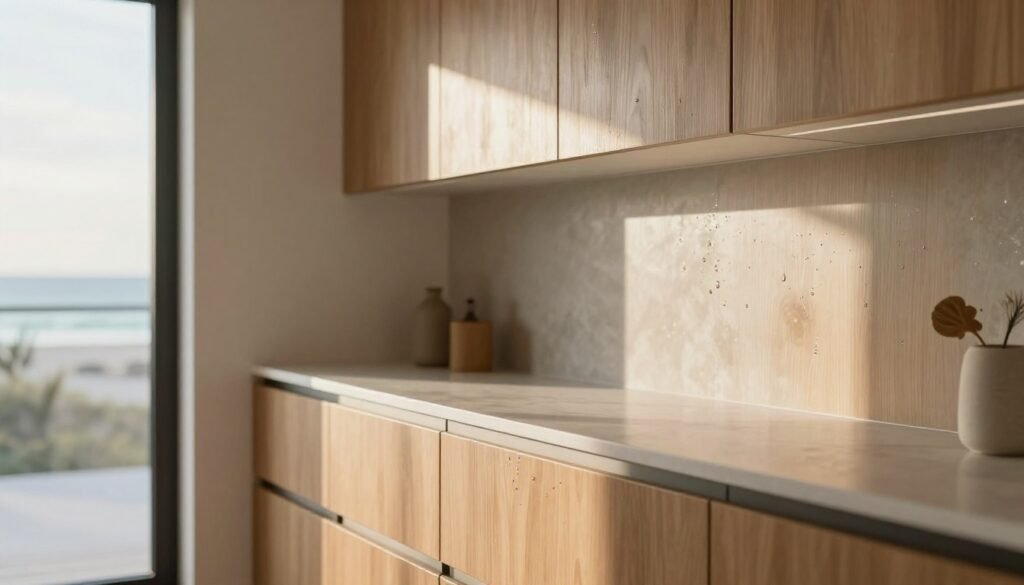
Salt air is great for sunsets, not so great for kitchen cabinets. In Fort Myers and across Lee County, moisture and salty particles can settle on surfaces every day. Over time, that mix can dull sheen, stain paint, swell weak materials, and speed up rust on hardware.
The good news is that the right finish works like sunscreen for your cabinetry. It forms a tight barrier, cleans up easily, and helps you avoid the sticky doors and chipped edges that show up in coastal homes. If you’re comparing cabinet finishes Fort Myers homeowners can count on, start with how salt air actually attacks your kitchen.
What salt air and humidity do to kitchen cabinets
Salt in the air doesn’t “eat” cabinets by itself. The trouble starts when salt sits on a surface and pulls in moisture. That damp film can linger on door fronts, around pulls, and along toe kicks. Add daily cooking steam and the AC cycling on and off, and cabinets see constant expansion and contraction.
Paint and clear coats handle that movement differently. A hard, brittle finish may look perfect in the showroom, then crack at corners later. A softer finish might resist cracking, yet scuff too easily near the trash pull-out. The best choice balances hardness, flexibility, and full coverage on every edge.
Material and build quality matter just as much as the topcoat. In coastal Florida, problems often begin where you can’t see them:
- Unsealed edges and backs: Raw MDF or particleboard edges can wick moisture fast, then swell.
- Thin coatings on door tops and bottoms: Those areas catch steam and splashes, but some shops spray them lightly.
- Exposed sink cabinet panels: Small leaks and wet sponges turn into stains and delamination.
- Low-grade hinges and slides: Salt air speeds corrosion, then doors sag and drawers scrape.
Finish also ties directly into cabinet design. For example, slab doors have fewer seams to trap grime, while deep profiles collect residue in humid kitchens. The best-looking layout still needs a finish that matches how you actually live.
If the back of the cabinet and the edges aren’t sealed, the “best” finish on the front won’t save it.
The best cabinet finishes for Fort Myers coastal kitchens (and when to choose each)
If you want cabinets that stay easy to wipe down, focus on factory-applied or shop-applied finishes that cure hard and form a tight film. These are the options that usually perform best in salt-air homes.
Conversion varnish and other catalyzed finishes
Conversion varnish (often used in professional shops) cures into a dense, chemical-resistant surface. It tends to handle cooking oils and frequent cleaning better than basic paint. It also resists the dulling you can get when salty moisture sits on doors.
Catalyzed lacquer can also work well when it’s sprayed correctly and allowed to cure fully. The key is build thickness and full coverage on edges, door tops, and door bottoms.
2K polyurethane (two-component) for painted cabinets
For a painted look, ask about a 2K polyurethane system or a comparable catalyzed topcoat over a quality primer. It’s a strong option for busy kitchens because it resists scuffs near knobs and holds up to regular wipe-downs. Satin and low-sheen finishes often look cleaner longer than dead-flat in humid areas because they wipe more easily.
If a contractor proposes a simple wall paint on cabinet doors, that’s a warning sign. Cabinets need coatings made for abrasion, skin oils, and repeated cleaning.
UV-cured factory finishes
Many quality cabinet lines use UV-cured coatings in controlled factory settings. Those finishes can come out consistent, smooth, and tough. They’re also less dependent on jobsite humidity, which helps in summer. If you’re buying pre-finished doors or boxes, ask what the factory uses and whether it’s UV-cured or catalyzed.
High-pressure laminate (HPL) and quality TFL for door faces
For families who cook a lot, laminates can be a practical choice. A good HPL surface is hard to stain and easy to clean, which matters when salty air leaves a film. Texture and edge detailing vary, so pay attention to the edge banding quality and whether seams are tight.
Thermofoil, proceed with caution near heat and salt air
Thermofoil doors can look great at first, but cheaper versions can fail in predictable ways. Heat and humidity can loosen the film, especially near ovens, dishwashers, or sun-exposed windows. Once the film starts to lift, cleaning moisture creeps underneath, and the door can’t be repaired invisibly.
Here’s a quick comparison to keep choices clear:
| Finish type | Best for | Why it works near the coast | Watch-outs |
|---|---|---|---|
| Conversion varnish | Wood or stained looks | Hard, resistant film, good cleanability | Needs pro application and cure time |
| Catalyzed lacquer | Smooth painted or stained doors | Stronger than basic lacquer, good wipe-down performance | Thin coats or rushed curing can fail |
| 2K polyurethane | Painted cabinets | Tough, scuff-resistant surface | Confirm VOC compliance and compatibility |
| UV-cured factory finish | Consistency and durability | Even build, strong curing process | Ask about coverage on edges and box interiors |
| HPL/TFL (quality) | Busy kitchens, easy cleaning | Resists staining and moisture on faces | Edge banding quality is everything |
| Thermofoil (budget) | Short-term refresh | Low maintenance at first | Peeling, bubbling near heat, hard to repair |
Maintenance that keeps coastal cabinet finishes looking new
A great finish still needs simple habits. Think of salt like a fine dust that turns sticky when it meets humidity. Removing it often is easier than scrubbing it later.
A wipe-down routine that works in Fort Myers
Use a soft microfiber cloth and a mild cleaner. Warm water with a small amount of gentle dish soap works for most finished surfaces. Wipe, then dry. That last step matters because standing moisture can leave mineral marks and soften grime.
Aim for this cadence:
- Weekly: Wipe door fronts, pulls, and the cabinet area near the stove.
- Monthly: Clean the top edges of doors and the underside of uppers, where film builds up.
- Seasonally: Pull out drawers, vacuum crumbs, then wipe the face frames and drawer fronts.
Cleaners to use, and what to avoid
Stick with mild, non-abrasive products. Avoid anything that leaves wax or silicone behind, since buildup can make future touch-ups harder.
Skip these in most cases:
- Abrasive powders and scrub pads (they scratch sheen)
- Bleach sprays on finished wood (can discolor and weaken coatings)
- Ammonia-heavy glass cleaners on paint (can dull some finishes over time)
- “Orange oil” polishes or waxy sprays (they attract grime)
If you want to use a specialty cabinet cleaner, confirm it matches your finish type. Also check local VOC rules and ventilation needs before using strong solvents in a closed kitchen.
Control moisture so cabinets don’t work overtime
Your HVAC does a lot, but coastal humidity still sneaks in. Run the range hood while cooking, use the bathroom fan if the kitchen shares airflow, and fix leaks fast. In damp seasons, a small dehumidifier can reduce sticky drawers and help finishes last longer.
Touch-ups without making a mess
Nicks happen, especially around trash pull-outs and sink bases. Use the touch-up method that matches your finish. Paint pens can work for small spots on painted doors, while stain markers may help on wood tones. For anything larger than a dime, get a matched touch-up kit from your cabinet supplier so color and sheen stay consistent.
Touch-ups look best when you match both color and sheen, because coastal light makes flaws stand out.
Red flags when shopping for coastal durability
If you’re investing in cabinets, don’t accept shortcuts that trap moisture. Walk away, or at least ask for upgrades, when you see:
- Boxes made from low-grade particleboard with exposed edges
- No sealing on cabinet backs, sink bases, or cutouts
- Soft-close hardware that isn’t corrosion-resistant
- Thermofoil placed right next to ovens without heat shields
- A finish plan that doesn’t mention cure time or edge coverage
Conclusion
The best cabinet finishes Fort Myers homeowners choose all share one trait: they block moisture and clean up fast. Catalyzed finishes, 2K systems, strong factory coatings, and well-made laminates can all perform well when the cabinet build is solid and edges are sealed. Pair the right finish with smart maintenance, and your kitchen stays crisp even when salt air is part of daily life. If you’re planning a remodel, prioritize durability first, then pick the color and sheen that fits your home.
