
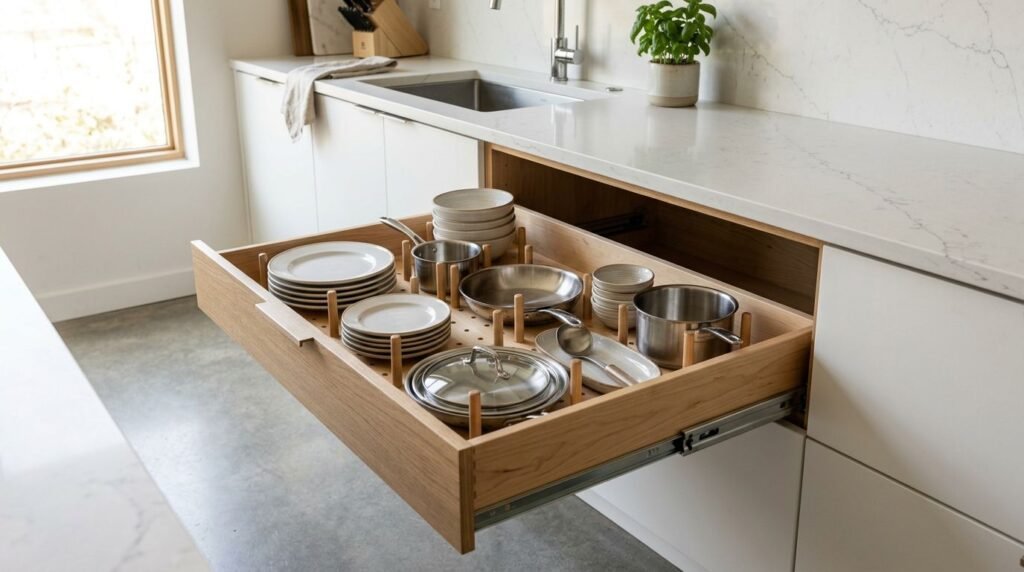
Kitchen clutter often starts when every item has a fixed spot that no longer fits. Pegboard drawer systems give plates, pans, lids, and serving pieces adjustable support inside a deep drawer, so the storage can change as your needs change.
Instead of lifting a stack to reach one dish, you can pull the drawer open and see the contents at once. When you’re choosing new cabinets, the insert, drawer height, hardware, and surrounding layout should be considered together. The right combination makes everyday storage easier without adding unnecessary cabinet bulk.
Why pegboard drawer systems work in base cabinets
A pegboard drawer system usually includes a drawer with a removable panel and movable pegs. You position the pegs around each item, creating separate spaces for dishes or other objects that might slide, lean, or stack poorly in a standard drawer.
The arrangement is more adaptable than a fixed divider. Large dinner plates may need wider spacing, while small bowls can fit closer together. If you replace a set of dishes later, you can move the pegs instead of replacing the entire organizer.
Base drawers also improve visibility. Traditional lower cabinets often require bending, reaching, and moving several items to find one pan or bowl. A drawer brings the contents forward, which helps you see what you own before buying duplicates.
A pegboard insert only saves space when the drawer height matches the items inside it. Extra depth can make access harder if dishes shift or stack too high.
These systems work best for items that benefit from upright or separated storage. Plates, shallow bowls, cookware lids, baking dishes, and serving platters are common choices. The pegs keep them from sliding across the drawer each time it opens.
However, pegboard isn’t the best answer for every category. Utensils usually need a shallow tray with narrow compartments. Knives need a dedicated knife insert or secure block. Small packets and spice containers may fit better in a shallow pull-out or a pantry organizer.
The goal is to give each item a storage position that matches its shape, weight, and frequency of use. Adjustable pegs are useful because they support the item without forcing every category into the same layout.
Plan the drawer around what you store
A successful system starts with the contents, not the cabinet catalog. Before meeting with a designer, group the items you want to store and note their approximate sizes. Include the pieces you use every week, not only the dishes displayed for special occasions.
Choose the right drawer height
A shallow drawer can hold plates and smaller bowls if the items rest securely on the insert. A taller drawer gives you more room for skillets, lids, casserole dishes, and larger serving pieces. Yet a taller box isn’t automatically better. If the drawer is too deep for the contents, items can shift or become difficult to lift.
Measure the largest pieces at their widest and tallest points. Include handles, rims, knobs, and lids. Then ask the cabinet designer for the usable interior dimensions, rather than relying only on the cabinet’s outside width.
Drawer fronts and interior boxes also have different measurements. A cabinet described as a certain width may provide less usable space after accounting for side walls, slides, and the drawer box. This kitchen cabinet sizes guide can help you compare standard cabinet measurements before finalizing a layout.
Keep heavy items low and accessible
Heavy cookware can work well in a deep drawer, but the drawer needs suitable slides and a properly built box. Store cast iron, large pots, and stoneware where you can lift them without reaching over other items.
A drawer near the cooktop can hold the pans used most often. Dishware may fit better near the dishwasher or dining area. Serving platters belong in a wide drawer near the island if you use the island for plating or entertaining.
Use the kitchen’s work pattern as a guide:
- Place everyday plates near the dishwasher or breakfast area.
- Keep pans close to the cooktop, with lids stored beside or above them.
- Reserve wide drawers for platters, baking dishes, and cutting boards.
- Put occasional serving pieces in a less central drawer or tall cabinet.
- Store heavy items in lower drawers that open fully and support their load.
Spacing matters as much as location. Leave enough room for fingers to grasp each item. If pegs sit too close together, the drawer may hold more objects on paper but become frustrating to use.
Choose inserts, pegs, and drawer hardware carefully
Pegboard components vary in size, shape, and material. Some systems use round pegs, while others use larger blocks or posts that support wider dishes. The correct option depends on the items and the drawer dimensions.
Look for an insert that can be removed for cleaning and adjusted without special tools. A stable base is important because loose panels can shift when a loaded drawer opens. Ask how the pegs lock into place, especially if you plan to store heavy plates or cookware.
Drawer hardware deserves equal attention. Full-extension slides let you reach the back of the drawer without unloading the front. Soft-close slides can reduce noise and help prevent abrupt closing, but the hardware must match the drawer’s size and load requirements.
| Storage job | Recommended drawer setup | Planning detail |
|---|---|---|
| Everyday dishes | Medium-height drawer with adjustable pegs | Position pegs around the largest plates and bowls |
| Pots and pans | Deep drawer with strong full-extension slides | Separate lids and protect the drawer bottom |
| Platters and baking dishes | Wide drawer with spaced supports | Check the diagonal length of oversized pieces |
For cookware, a pegboard insert can work alongside a deeper drawer rather than replacing every organizer. A separate lid divider may keep flat lids upright, while pegs hold skillets or baking dishes in place. These combinations reduce stacking and make the drawer easier to scan.
If pots and pans are your main problem, review these pot and pan drawer cabinets before choosing a peg layout. The drawer size and placement may solve more of the access problem than the insert alone.
Avoid putting loose sharp tools in a general pegboard drawer. A knife can shift when the drawer opens, so it needs a secured storage solution. The same principle applies to fragile glassware, which may require padded dividers or a more protected cabinet location.
Build the system into your cabinet design
Pegboard storage works best when planned before the cabinet order is complete. The drawer width, interior height, slide type, and insert size all affect one another. Adding an organizer after installation may limit your choices.
That decision belongs in the cabinet design stage, when you can compare drawer bases, door cabinets, islands, and tall units as one plan. A wide drawer base may offer better access than two narrow drawers. A tall pantry cabinet may hold food and appliances more efficiently than several small wall cabinets.
Measure the available run beside appliances, walls, and corners. Check that a fully open drawer won’t strike an appliance handle or block a walkway. In an island, confirm that the drawer opening works from the side of the kitchen where you prepare food.
The dishwasher location also matters. If dishes move directly from the dishwasher into a nearby pegboard drawer, unloading becomes faster. On the other hand, a drawer across the room may be a better choice for serving pieces that aren’t used during every meal.
Tall storage can take pressure off lower drawers. A well-planned kitchen pantry cabinet can hold dry goods, countertop appliances, and less-used kitchenware, leaving pegboard drawers for the items you handle daily.
Before approving the layout, request a drawing that shows drawer widths and clearances. Ask where the insert will sit inside the box and whether the drawer can be removed for service. Confirm the finished interior dimensions after the cabinet, slide, and insert specifications are set.
Keep adjustable drawer storage useful over time
A pegboard system needs occasional adjustment. When you buy new dishes or change how you cook, move the pegs rather than forcing new items into an old arrangement. Keep frequently used pieces toward the front and group items by task.
Clean the insert with the method recommended by the cabinet maker. Wipe spills promptly, especially around unfinished edges or joints. Avoid overloading the drawer beyond the slide manufacturer’s stated capacity.
Check the drawer once or twice a year. Loose pegs, rubbing sides, or a drawer that no longer closes smoothly can indicate a fit or hardware problem. Fixing small issues early protects both the organizer and the cabinet box.
The best setups also leave a little open space. A drawer packed edge to edge may look efficient, but it gives you no room to add a serving bowl or change the peg positions. Adjustable storage should have enough flexibility to stay useful after the renovation is finished.
Make every drawer earn its space
Pegboard drawer systems are most effective when they match the way your kitchen operates. Use them for dishes, cookware, lids, and serving pieces that need support and visibility. Choose shallow trays, dividers, or knife inserts for categories that need a different form of organization.
Start by measuring the largest items, then select the drawer height, width, slides, and peg layout together. A well-planned drawer can replace awkward stacking and make lower cabinet storage easier to reach every day. The difference comes from fitting the system to your habits, not from filling every inch of the cabinet.