 Skip to content
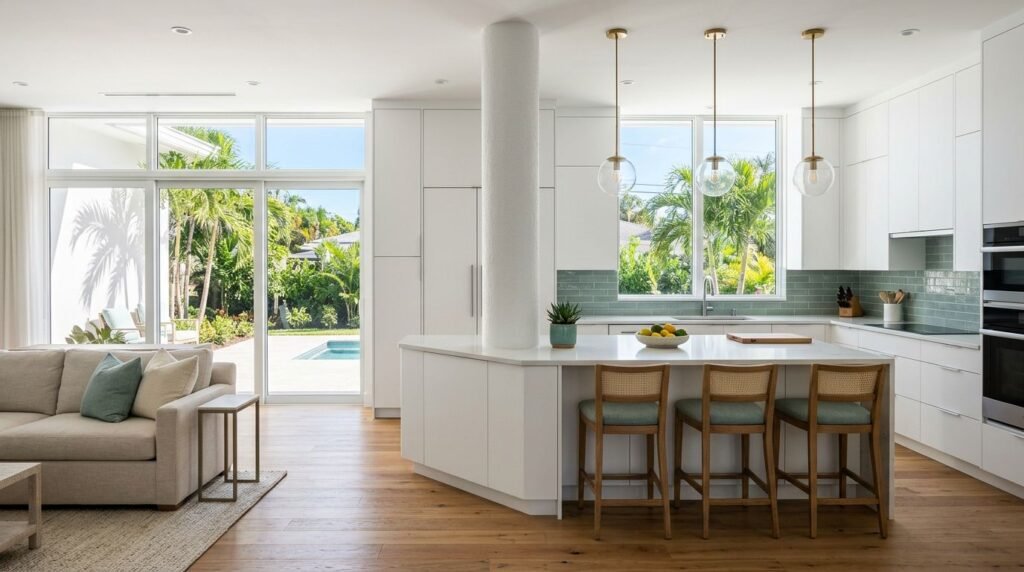
Kitchen columns can throw a cabinet plan off fast. One post in the wrong spot can narrow a walkway, break a clean run, or leave you with odd filler pieces.
With the right cabinet design, though, a column can look built in instead of awkward. The key is to plan the cabinets around the structure before you choose finishes, hardware, or door styles.
That matters even more in Fort Myers homes, where open layouts often put the kitchen in view from the living or dining area. When kitchen columns and cabinets share the same wall, balance matters as much as storage.
Start with the column, not the cabinet style
A column changes more than the look of a kitchen. It changes the rhythm of the room.
Straight cabinet lines are easy to plan. A column breaks that line, so the layout has to answer a few questions. Does the column divide the room? Does it sit near an aisle? Does it force the cabinets to stop and start in awkward places?
A good plan treats the column like a fixed point, then builds around it. That means thinking about symmetry, traffic flow, and how the kitchen feels from a few steps away. A cabinet run that looks fine on paper can feel cramped once a column lands in the middle.
A column should look planned, not patched in after the fact.
This is where many kitchens miss the mark. They focus on cabinet finish first, then try to solve the structure later. That usually leads to thin fillers, uneven upper lines, or a run of cabinets that looks squeezed.
Instead, picture the column as part of the room’s frame. Cabinets can meet it cleanly, stop short of it on purpose, or wrap around it with a feature piece. The right choice depends on the space around it.
Measure the space in three directions
Good planning starts with exact numbers. Guessing almost always causes trouble later.
Measure the column width, depth, and height first. Then measure the distance from the column to nearby walls, windows, appliances, and door openings. A column that looks centered from one angle may sit off-center once the cabinet run starts.
Also measure the working space around it. A kitchen needs room for someone to open drawers, pull out a trash bin, or stand at the sink without bumping into a corner. In a tight Fort Myers kitchen, a few inches can decide whether the layout feels easy or cramped.
Keep these measurements on one sketch:
- Column width and depth
- Distance from the column to each wall
- Ceiling height near the column
- Distance to appliance doors and drawer fronts
- Walking space on both sides of the column
If the floor or ceiling is uneven, note that too. Older homes often shift a little over time, and that can affect upper cabinet alignment. Even small slope changes matter when cabinets need to meet a column cleanly.
You also want to think about sightlines. Stand where people enter the kitchen. Look at how the column lines up with the island, sink wall, or pantry run. A few inches of placement can change how balanced the whole room feels.
The best time to correct a measurement problem is before any cabinets are ordered.
Cabinet layouts that work well around a column
Some layouts handle a column better than others. The right one depends on how much wall space you have and how the room is used.
This table gives a quick side-by-side view of common cabinet approaches.
| Layout choice | Best when | Watch out for |
|---|---|---|
| Split cabinet runs | The column sits near the middle of a wall | Uneven spacing if the two sides are not balanced |
| Wraparound base cabinets | The column is close to a corner or peninsula | Tight corners and awkward door swings |
| Tall cabinet anchor | You need a strong visual stop near the column | Overpowering a small kitchen |
| Open shelving or display section | You want the column to feel lighter | Too much open space can reduce storage |
A split run often works well when the column naturally divides the kitchen into zones. One side can hold prep storage, while the other side supports cooking or cleanup. That keeps the layout useful and gives the column a clear role.
Tall cabinets can also help. A pantry or oven cabinet near the column can create a strong edge, so the column feels like part of a larger structure. This works well when the room needs vertical balance.
Wraparound layouts need care. They can make sense near a peninsula or island, but the corners must stay usable. If the cabinet fronts crowd the path, the layout loses comfort fast.
Open shelves can soften a column and lighten the room. They also work well when the kitchen already has enough closed storage elsewhere.
The goal is simple. Give the column a purpose, then let the cabinets support that purpose.
Make the column look like part of the design
A column feels awkward when it looks separate from everything around it. The fix is usually visual, not structural.
Start by matching the cabinet height lines. If upper cabinets stop at one level on one side and another level on the other, the column will stand out more. When the tops, toe-kicks, and trim lines align, the room looks calmer.
Color helps too. A column can blend in when it shares trim or paint tones with nearby cabinets. On the other hand, a contrasting finish can work if you want the column to act like a feature. Both choices can look right, but each one needs a clear plan.
Material details matter as well. A narrow panel next to the column, a finished side panel, or a small run of molding can make the transition look clean. The goal is to avoid the “stuck on later” look.
Lighting also changes how the column reads. A soft light over a cabinet run or under a shelf can pull attention toward the whole wall instead of the post alone. In open kitchens, that matters more than people expect.
If you want the column to disappear, use clean vertical lines and keep the cabinet faces simple. If you want it to stand out, repeat its shape in a nearby tall cabinet or pantry. Either way, the column should feel intentional.
Know when to keep the boxes and when to start over
Some column problems are layout problems. Others are cabinet problems.
If the cabinet boxes are solid and the sizes are close to what you need, a lighter update may be enough. That’s where choosing between refacing and replacement becomes useful. Refacing can work when the structure is sound and the main issue is appearance.
Replacement makes more sense when the column forces poor cabinet sizes, bad clearances, or wasted space. If you need a custom filler, a strange corner, or a shortened run that cuts into storage, new cabinets may solve the problem better.
That decision also depends on the room’s shape. A column in the middle of the wall can often be integrated with better paneling or a revised layout. A column that blocks a traffic path may call for a bigger change.
Before you decide, ask one question: does the current cabinet structure fit the column, or are you trying to make it fit after the fact? That answer usually points to the right path.
For homeowners in Fort Myers, this choice matters because kitchens often connect to living areas. A small cabinet issue can affect how the whole room feels. The right fix should improve both storage and the view.
Common mistakes that make columns look awkward
The most common mistake is ignoring clearance. A cabinet that fits the wall may still fail if a door hits the column or a drawer stops short.
Another mistake is forcing perfect symmetry where it doesn’t belong. A column is already a visual break, so cabinets do not need to mirror each other at all costs. Sometimes an off-center pantry or wider prep zone makes more sense.
Too much filler is another red flag. Filler can solve a sizing issue, but too much of it looks like a compromise. A few inches can work. A large gap usually means the plan needs to change.
Homeowners also forget about the view from the next room. In an open layout, the column is not just a kitchen detail. It is part of the living space too. That means the cabinet finish, height, and trim should all look good from more than one angle.
Finally, don’t skip a full-scale mockup or layout review. Even a simple taped outline on the floor can show whether a cabinet door will swing cleanly or a walkway feels tight. That small step can save a lot of hassle later.
Conclusion
A kitchen column does not have to fight your cabinet plan. When you measure carefully, choose the right layout, and match the trim and height lines, the column becomes part of the room instead of a problem to hide.
The best kitchen columns cabinets plan keeps storage useful, traffic clear, and the whole kitchen balanced. When those three things work together, the column starts to feel like it belongs there.
