 Skip to content
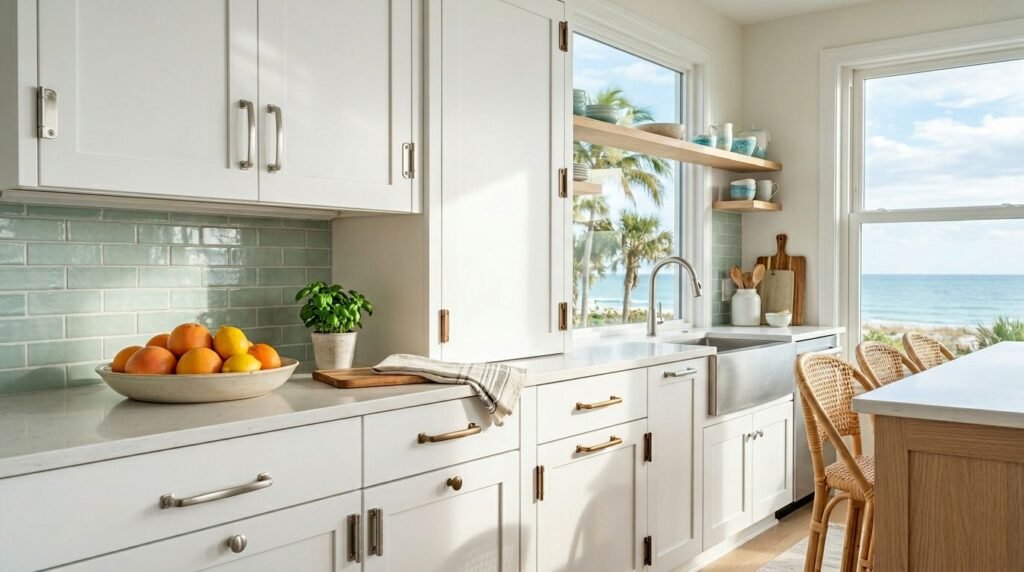
Salt air has a way of finding the smallest weak spot. It sneaks into tiny scratches, sits in damp corners, and then your “new” pulls start to look tired. If you’re remodeling in Southwest Florida, choosing coastal cabinet hardware is less about trends and more about survival.
The good news is that you can get the look you want and avoid the most common corrosion problems. The key is matching the finish (and the base metal under it) to your home’s humidity, salt exposure, and daily use.
Below are the finishes that make sense for Coastal Florida kitchens, plus a quick comparison table, scenario-based picks, and care tips that actually work.
Why coastal Florida eats hardware (and what that means for cabinet design)
Coastal air isn’t just “humid.” It often carries chloride salts. Those salts attract moisture and stay active on metal surfaces, even when everything looks dry. As a result, hardware can corrode faster here than it would inland.
A few things speed up damage:
Salt, humidity, and heat cycles, which push moisture into seams and around mounting posts.
High-touch areas, where skin oils and cleaners wear away protective topcoats.
Splash zones, like the sink run and the dishwasher side, where warm steam hits cooler metal and condenses.
That’s why finish alone isn’t the whole story. Cabinet design choices like long pulls, integrated appliance pulls, and oversized knobs create more contact points and more leverage on fasteners. If the screw corrodes, the best-looking handle still fails.
Mixed metals can also cause trouble. For example, a stainless pull installed with low-grade steel screws can rust at the screw head first, then stain the finish around it.
If you’re close enough to smell the tide from your driveway, treat hardware like exterior hardware. Pick materials and finishes that expect salt.
Want to see how finishes look in real kitchens? Browsing a view portfolio of coastal cabinet designs can help you spot what reads “beachy,” what reads “modern,” and what still looks clean after heavy use.
Finishes and materials that hold up best in salt air
Not every “coastal-friendly” label means much. Focus on the coating type, the base metal, and whether the finish is built to resist pitting.
PVD finishes (best all-around for many Florida kitchens)
PVD (physical vapor deposition) is a thin, hard coating bonded to the surface. In plain terms, it tends to resist scratching and wear better than many standard plated finishes. That matters because scratches and worn edges are where corrosion often starts.
PVD is common in modern looks like satin brass, graphite, and black stainless tones. Still, ask what’s under the coating. A strong coating over a weak base metal can only do so much.
Powder-coated and painted metals (great for matte black, if you treat chips seriously)
A quality powder coat can perform well in humid, salty areas because it forms a barrier layer. Matte black hardware in coastal homes often looks best in a powder-coated finish because it hides fingerprints and water spots.
The weak point is impact. If a powder coat chips down to bare metal, salt can creep under the surrounding coating and spread.
Stainless steel (choose 316 when salt exposure is high)
Stainless is a smart choice for kitchens because it doesn’t rely on a decorative topcoat. It’s the material itself that resists corrosion.
For Coastal Florida, stainless usually comes down to 304 vs 316:
- 304 stainless: Common, good general corrosion resistance, often fine for inland coastal homes.
- 316 stainless: Better in salt environments because it’s formulated for stronger chloride resistance. It’s a safer bet for beachfront condos and homes exposed to salt spray.
A brushed stainless look also helps because it disguises fine scratching and spotting better than mirror polish.
Brass: lacquered vs unlacquered (pick based on your patience)
Brass can be a great coastal look, but the protective layer matters.
- Lacquered brass tries to “freeze” the color. In humid kitchens, that clear coat can wear at edges and high-touch points, then look patchy.
- Unlacquered brass (often called a living finish) will darken and patina. It won’t peel, but it will change. If you like a steady, uniform color, it can drive you nuts. If you like character, it’s a win.
Why some plated finishes pit and tarnish faster near the coast
Many shiny “polished nickel” or “chrome-look” options are electroplated over a base metal. Plating can have tiny pores. Salt and moisture reach the substrate through those pores, then you get pitting, bubbling, or edge corrosion. On top of that, thin clear topcoats wear off where you grab the pull every day.
Polished finishes also show damage sooner. Brushed and satin finishes don’t stop corrosion, but they hide early wear much better.
Coastal cabinet hardware finishes compared (quick table)
Here’s a fast way to compare common options before you order.
| Finish/material | Durability in salt air | Look/style fit | Maintenance level | Typical price tier |
|---|---|---|---|---|
| PVD over quality base metal | High | Modern, transitional, “clean brass” looks | Low | Mid to high |
| Powder-coated metal (matte black) | Medium to high (watch for chips) | Modern, coastal modern, farmhouse | Low to medium | Mid |
| 316 stainless steel | Very high | Contemporary, commercial, minimal | Low | High |
| 304 stainless steel | Medium to high | Contemporary, timeless | Low | Mid |
| Lacquered brass | Medium (can wear at touch points) | Classic, warm, upscale | Medium | Mid to high |
| Standard electroplated finishes | Low to medium (pitting risk) | Shiny traditional, bright metals | Medium to high | Low to mid |
The simple takeaway: if your home gets real salt exposure, prioritize PVD, 316 stainless, or a proven powder coat over basic plating.
Best finish choices by scenario (Florida-realistic recommendations)
The “best” finish depends on where the kitchen lives and how it’s used.
Beachfront or barrier island homes: Choose PVD or 316 stainless for most pulls and knobs. Keep polished finishes to a minimum because spotting and micro-scratches show faster.
Inland coastal (a few miles from the water): 304 stainless, PVD, and powder-coated hardware often work well. You can also use lacquered brass, but plan to wipe it down more often.
Near the sink, dishwasher, or trash pull-out: Pick the most corrosion-resistant option you can. Warm steam plus detergent residue is rough on finishes. PVD and stainless shine here, while plated finishes tend to dull and pit sooner.
Rentals and VRBOs: Go for durable, low-drama finishes that hide wear. Powder-coated matte black and brushed stainless are reliable choices. Avoid living finishes unless you want guest cleaners trying to “fix” patina with harsh chemicals.
High-touch zones (pantry, fridge panels, beverage drawers): Favor satin or brushed textures. They handle constant contact better and don’t broadcast fingerprints.
If you’re balancing all these factors during selection, it helps to work with a team that’s used to coastal projects. Getting input early from meet our Fort Myers cabinet designers can prevent mismatch problems, like a beautiful finish paired with the wrong base metal or screw type.
Maintenance that actually helps (and what to avoid)
In coastal kitchens, gentle and frequent wins.
Clean weekly with a soft microfiber cloth and warm water, then dry.
For heavier grime, use mild dish soap in water, rinse with a damp cloth, then dry again.
After a storm week or heavy salty air, do a quick wipe-down so residue doesn’t sit.
Avoid bleach, ammonia, vinegar, and abrasive powders. Skip scouring pads too. Those products can attack clear coats, dull plated finishes, and scratch stainless, which gives salt more places to cling.
If a cleaner can “restore” shine in one pass, it’s often removing something you needed.
FAQ: Coastal Florida cabinet hardware finishes
Is matte black hardware a bad idea near the beach?
Not if it’s a quality powder coat or PVD. The risk is chipping. Treat impacts seriously and replace damaged pieces early.
Will stainless steel hardware rust?
It can stain or pit in harsh conditions, especially lower grades. For heavy salt exposure, 316 is the safer choice than 304.
Should I choose polished or brushed finishes?
Brushed and satin finishes look better longer in coastal homes. Polished finishes show spots, scratches, and early pitting sooner.
Is unlacquered brass “low maintenance”?
It’s low maintenance if you like patina. It’s high maintenance if you want it to stay bright and uniform.
Conclusion
Coastal homes don’t need boring hardware, they need smart hardware. Start with salt-resistant materials, then pick finishes that won’t fail at the first scratch. For most kitchens, coastal cabinet hardware in PVD, powder coat, or stainless (often 316 near the water) gives the best balance of style and durability. Choose based on your location, your cleaning habits, and your home’s daily traffic, then keep it simple with gentle wipe-downs.
